



Life rarely follows a perfectly predictable path. Unexpected changes, relationship challenges, professional pressures, financial concerns, disappointment, and periods of uncertainty can test our confidence and sense of balance.
During difficult times, it is natural to look for answers outside ourselves. But developing inner strength can help us respond to life’s challenges with greater awareness, patience, resilience, and self-trust.
Inner strength does not mean never feeling stressed, sad, uncertain, or overwhelmed. Instead, it means developing the ability to acknowledge difficult experiences while continuing to move forward with intention.
For many people, spiritual practices, self-reflection, mindfulness, healthy routines, and supportive guidance can become useful tools for cultivating this inner foundation.
Cultivating Inner Strength: Practical Tools to Help You Navigate Life’s Challenges, Restore Inner Balance, and Move Forward with Greater Clarity.
What Is Inner Strength?
Inner strength is the capacity to remain grounded and purposeful when life becomes difficult.
It can involve several qualities, including:
- Self-awareness
- Emotional resilience
- Patience
- Self-confidence
- Adaptability
- Healthy boundaries
- Self-compassion
- Spiritual awareness
- The ability to learn from difficult experiences
Being strong does not mean ignoring difficult emotions. In fact, recognising what you are feeling can be an important part of developing resilience.
Instead of asking, “Why is this happening to me?” you may sometimes find it more useful to ask:
What can this experience teach me, and what can I do next?
That small shift can change the way you approach obstacles.
Why Inner Strength Matters During Difficult Times
Challenges can make life feel uncertain. When several difficulties happen at once, it can become easy to lose perspective and focus only on what is going wrong.
Inner strength can help you create space between an event and your response to it.
For example, losing an opportunity may initially create disappointment. Developing resilience does not mean pretending that the disappointment does not matter. It means allowing yourself to process the experience while remaining open to what comes next.
This approach can encourage:
- More thoughtful decision-making
- Greater self-awareness
- Better emotional boundaries
- A stronger sense of purpose
- Greater ability to adapt to change
- More patience with yourself and others
Inner strength is therefore not something you either have or do not have. It can be cultivated gradually through everyday practices.
7 Practical Ways to Cultivate Inner Strength
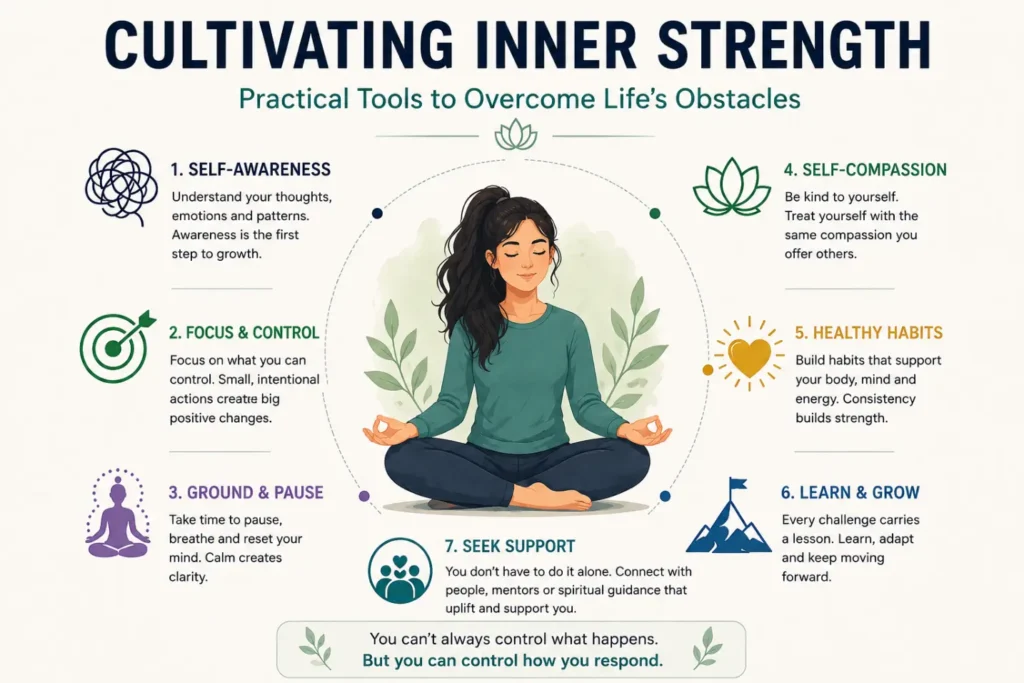
Practice Honest Self-Reflection
Self-reflection is one of the simplest ways to understand yourself more deeply.
Set aside a few quiet minutes each day and ask yourself:
- What am I feeling today?
- What is causing the most tension in my life?
- What is within my control?
- What is outside my control?
- What do I need right now?
- What can I learn from my current situation?
Writing your thoughts in a journal can make this process easier.
You do not need to write pages every day. Even five to ten minutes of honest reflection can help you recognise recurring thoughts, emotions, habits, and patterns.
The purpose is not to criticise yourself. It is to understand yourself.
Focus on What You Can Control
One of the most useful approaches to overcoming life’s obstacles is learning to distinguish between what you can control and what you cannot.
You may not be able to control another person’s decisions, an unexpected change, or something that has already happened.
You can, however, influence:
- How you communicate
- How you spend your time
- The boundaries you establish
- The choices you make today
- How you respond to setbacks
- Whether you ask for appropriate support
When your attention is constantly focused on things outside your control, life can feel overwhelming.
Bringing your attention back to your next constructive step can restore a sense of direction.
Develop a Grounding Practice
Grounding practices can help create moments of calm and awareness during busy or challenging periods.
A grounding routine might include:
- Sitting quietly for several minutes
- Slow, comfortable breathing
- Spending time outdoors
- Prayer or spiritual reflection
- Meditation
- Journaling
- Gentle movement
- Limiting unnecessary digital distractions
The goal is not to eliminate every difficult thought.
Instead, grounding allows you to pause, observe your experience, and return your attention to the present moment.
Choose a practice that feels realistic enough to maintain consistently.
Build Self-Compassion
Many people speak to themselves in ways they would never speak to a close friend.
After making a mistake, you might think:
“I always get things wrong.”
“I am not strong enough.”
“I should have handled everything better.”
This type of self-criticism can make difficult situations feel even heavier.
Self-compassion involves treating yourself with understanding while still taking responsibility for your choices.
Try replacing harsh self-judgment with a more balanced question:
“What would I say to someone I care about who was experiencing this?”
You can acknowledge mistakes without defining yourself by them.
Create Meaningful Daily Habits
Inner strength is built through repeated actions, not one dramatic moment.
Simple habits can create a stronger foundation for navigating difficult periods.
Consider establishing a daily routine that includes:
- Adequate rest
- Nutritious meals
- Regular physical activity
- Time away from screens
- Personal reflection
- Meaningful relationships
- Time for hobbies or creativity
- Spiritual or mindfulness practices
You do not need to transform your entire lifestyle overnight.
Start with one sustainable habit and build from there.
Consistency is often more valuable than intensity.
Learn From Difficult Experiences
Obstacles can sometimes reveal things about ourselves that comfortable periods do not.
A difficult experience may encourage you to reconsider:
- Your priorities
- Your relationships
- Your boundaries
- Your expectations
- Your definition of success
- What gives your life meaning
This does not mean every difficult event has a positive purpose or that you should “be grateful” for hardship.
Rather, once you have processed an experience, you can choose what you want to carry forward.
Ask yourself:
“What did I learn about myself through this experience?”
That question can turn reflection into growth.
Seek Support and Spiritual Guidance When Appropriate
Developing inner strength does not mean doing everything alone.
Trusted friends, family members, mentors, counsellors, community leaders, or appropriate professional support can provide perspective when life feels difficult.
For people who value spirituality, spiritual guidance and energy-based wellness practices may also become part of their personal reflection and wellbeing routine.
An aura reading or spiritual wellness session, for example, can be approached as an opportunity for reflection, insight, and exploring personal patterns.
At Aura Repair, these practices are offered as spiritual and wellness services rather than medical diagnosis or treatment.
The important principle is to choose support that aligns with your values and circumstances.
A Simple Daily Inner-Strength Routine
You do not need an elaborate routine to begin.
Try this five-step practice:
Morning — Set an intention
Ask:
“How do I want to show up today?”
Choose one quality such as patience, courage, kindness, focus, or calm.
During the day — Pause
When you experience tension or frustration, take a brief pause before reacting.
Ask:
“What is actually within my control right now?”
Evening — Reflect
Write down one challenge you experienced and one thing you learned from it.
Practice gratitude
Identify one thing you genuinely appreciate.
It can be something very simple: a conversation, a meal, a peaceful moment, or progress toward a goal.
End with self-compassion
Remind yourself:
“I am learning, growing, and doing what I can with what I know today.”
Small practices like these can gradually become part of a more intentional lifestyle.
Inner Strength Is a Journey, Not a Destination
There will be days when you feel confident and grounded, and there will be days when you feel uncertain again.
That does not mean you have failed.
Resilience is not about permanently eliminating difficult emotions. It is about learning how to meet life’s changing circumstances with greater awareness and flexibility.
Sometimes the strongest choice is to pause.
Sometimes it is to ask for help.
Sometimes it is to establish a boundary.
Sometimes it is to let go of something that no longer serves you.
And sometimes it is simply to take the next small step.
Final Thoughts
Cultivating inner strength does not require becoming a different person.
It begins with understanding yourself, accepting that challenges are part of life, and developing practical ways to respond to them.
Start small.
Reflect on what matters to you. Focus on what you can control. Build grounding habits. Practice self-compassion. Learn from your experiences. Maintain meaningful connections. And, when appropriate, explore forms of spiritual guidance that support your personal journey.
You do not have to overcome every obstacle today.
Sometimes, inner strength means having enough awareness to take the next step.
Explore Spiritual Guidance and Wellness with Aura Repair
If you are interested in exploring aura reading, spiritual guidance, or energy-based wellness as part of your personal reflection journey, learn more about Aura Repair’s services and discover an approach that aligns with your goals and values.
Frequently Asked Questions
(01) What is the best way to develop inner strength?
There is no single method that works for everyone. Self-reflection, healthy routines, mindfulness, supportive relationships, meaningful goals, spiritual practices, and learning from difficult experiences can all contribute to developing greater inner resilience.
(02) Can spiritual practices help build inner strength?
For people who value spirituality, practices such as prayer, meditation, reflection, spiritual guidance, and other personal rituals can offer opportunities to slow down, reconnect with personal values, and deepen self-awareness. Their usefulness can vary from person to person.
(03) How can I stay strong when life feels overwhelming?
Start by focusing on what you can control today rather than trying to solve everything at once. Break challenges into smaller steps, maintain supportive routines, give yourself time to process difficult emotions, and consider seeking appropriate support when needed.
(04) What is the difference between inner strength and emotional strength?
The two ideas overlap. Emotional strength often refers to the ability to recognise and constructively manage difficult emotions. In contrast, inner strength can encompass emotional resilience, self-awareness, values, purpose, adaptability, and confidence in navigating challenges.
(05) Can an aura reading help with personal growth?
An aura reading can be approached as a spiritual wellness experience that encourages reflection and personal insight. People may use it as an opportunity to explore perceived energetic patterns, personal experiences, and areas of focus. It should not be considered a medical diagnosis or a replacement for qualified healthcare or mental-health support.
(06) When should I seek professional support?
If difficulties are significantly affecting your daily life, relationships, safety, or ability to function, consider seeking support from an appropriately qualified healthcare or mental-health professional. Spiritual or wellness practices can complement a person’s personal routine, but they should not replace appropriate professional care.


