



Everyday stress is a normal part of life. Work responsibilities, family commitments, financial concerns, relationship challenges, and unexpected problems can all affect how we feel. While it may not always be possible to remove stress completely, we can learn how to respond to it in healthier ways.
Emotional balance is the ability to recognise, understand, and manage your emotions without letting temporary feelings dictate every decision or reaction. It does not mean being happy all the time or avoiding difficult emotions. Instead, it means developing the ability to experience emotions while remaining grounded and aware.
When stress becomes overwhelming, people may feel irritated, mentally exhausted, anxious, disconnected, or emotionally drained. Learning how to achieve emotional balance can help you create space between what happens to you and how you respond.
This guide explores practical, mindful ways to manage stress and emotions, strengthen emotional resilience, and foster greater inner balance in everyday life.
Emotional balance begins when you learn to pause, understand your feelings, and respond to everyday stress with greater clarity and inner calm. — Ijaz Khan
What Is Emotional Balance?
Emotional balance is not about suppressing emotions. Everyone experiences anger, sadness, frustration, fear, excitement, and disappointment. The goal is not to eliminate these feelings but to develop a healthier relationship with them.
A person with emotional balance can usually pause, recognise what they are feeling, and choose how to respond. For example, instead of immediately reacting to a stressful situation with anger, they may take time to understand what caused the reaction and decide what action is most helpful.
Emotional balance often involves:
- Awareness of your feelings
- The ability to pause before reacting
- Healthy emotional expression
- Greater self-awareness
- Practical stress management habits
- Healthy boundaries
- Self-compassion during difficult moments
Emotional balance can also change from day to day. You may feel calm and focused one day and overwhelmed the next. This does not mean you have failed. Developing emotional well-being is an ongoing practice.
How Everyday Stress Affects Emotional Well-Being
Stress affects both the mind and body. When your daily responsibilities feel constant or overwhelming, your emotional reactions may intensify.
You may notice that small problems feel bigger than usual. A minor disagreement can become frustrating, an unexpected change can feel overwhelming, or simple decisions can require more mental energy than normal.
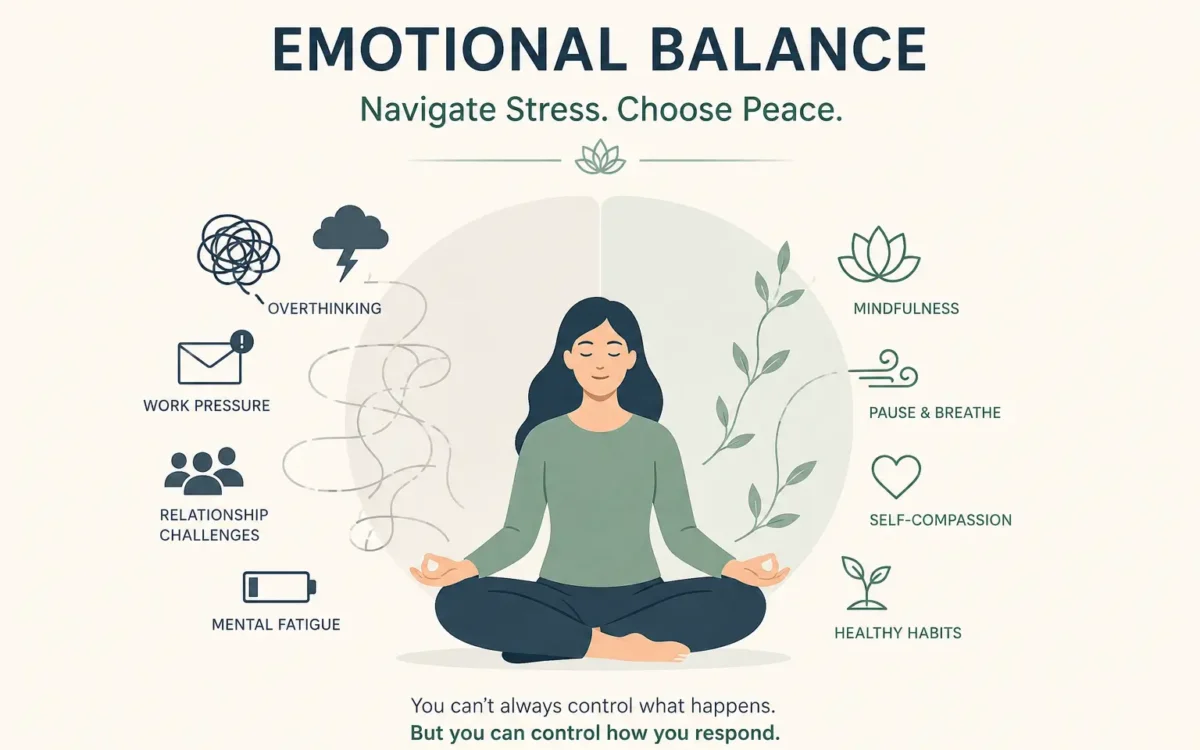
Common signs of emotional stress include:
- Feeling easily irritated
- Difficulty concentrating
- Constant overthinking
- Emotional exhaustion
- Feeling disconnected from yourself
- Changes in sleep patterns
- Increased tension in the body
- Difficulty relaxing
- Feeling overwhelmed by ordinary responsibilities
The important point is that stress is not always caused by one major event. Sometimes, emotional exhaustion develops gradually through repeated daily pressure.
Learning how to manage everyday stress can help prevent these pressures from building into a constant state of emotional overwhelm.
Recognise Your Emotions Without Judging Them
One of the first steps toward emotional balance is recognising what you are actually feeling.
Many people say, “I feel bad” or “I feel stressed,” but emotions are often more complex. You may be feeling disappointed, worried, lonely, frustrated, guilty, or emotionally exhausted.
Try asking yourself:
What am I feeling right now?
What happened before this emotion appeared?
Where do I feel this emotion in my body?
What do I need at this moment?
Naming an emotion can make it easier to understand. You do not need to judge yourself for feeling it.
For example, instead of thinking, “I should not be angry,” try saying, “I am feeling angry right now, and I want to understand why.”
This approach can create emotional awareness and reduce impulsive reactions.
Pause Before You React
Stress often creates a sense of urgency. You may feel pressured to answer immediately, make a quick decision, or react when emotions are high.
A simple pause can be a powerful emotional regulation technique.
Before responding, try:
- Taking a slow breath
- Relaxing your shoulders
- Giving yourself a few seconds
- Asking whether your response will help the situation
- Choosing your next action more intentionally
This does not mean you should ignore problems. It simply gives your mind time to move from automatic reaction toward a more thoughtful response.
The more you practise pausing during stressful moments, the easier it can become to stay emotionally balanced.
Use Simple Breathing and Grounding Techniques
When your mind is racing, bringing attention back to the present moment can help you feel more grounded.
Try this simple exercise:
- Place both feet on the floor.
- Take a slow, comfortable breath.
- Notice three things you can see.
- Notice two things you can hear.
- Pay attention to one physical sensation in your body.
You can also try slow breathing by inhaling comfortably and allowing your exhale to be gentle and unforced.
Grounding techniques do not solve every problem, but they can help you create a moment of calm before deciding what to do next.
For people who are exploring spiritual well-being, quiet reflection, meditation, or mindful practices may also support a greater sense of inner connection. The most helpful approach is one that feels safe, practical, and sustainable for your daily life.
Set Healthy Boundaries Around Your Time and Energy
Many people experience emotional stress because they feel responsible for everything and everyone.
Healthy boundaries can protect your time, attention, and emotional energy.
Setting boundaries may mean:
- Saying no when your schedule is already full
- Taking a break before responding to difficult messages
- Limiting unnecessary conflict
- Asking for help when you need it
- Creating time away from work
- Reducing exposure to situations that repeatedly drain you
A boundary is not about controlling other people. It is about being clear about what you can realistically give.
When you regularly ignore your own limits, stress can build into resentment and emotional exhaustion. Protecting your energy can be an important part of developing emotional balance.
Build a Daily Routine That Supports Emotional Well-Being
You do not need a perfect routine to improve emotional resilience. Small, consistent habits can make a meaningful difference.
Consider including simple practices such as:
- A regular sleep schedule
- A short daily walk or movement
- Time away from screens
- Regular meals and hydration
- Quiet time for reflection
- Journaling your thoughts
- Spending time with supportive people
A daily routine provides structure when life feels unpredictable. Even a few minutes of intentional self-care can create opportunities to check in with yourself.
Instead of trying to change everything at once, choose one habit that feels realistic. Consistency is often more useful than creating an ambitious routine that is difficult to maintain.
Stop Fighting Every Difficult Emotion
Difficult emotions often become more intense when we constantly fight them.
If you are sad, frustrated, or disappointed, you may immediately try to push the feeling away. However, emotional balance often involves allowing yourself to acknowledge an emotion before deciding what to do with it.
You can say:
“This is a difficult moment, but I can allow myself to feel what I am feeling.”
This is not the same as giving up or becoming stuck in negative emotions. It means creating enough space to understand the emotion rather than reacting automatically.
Sometimes, a difficult emotion may be showing you that you need rest, support, a boundary, or a change in your circumstances.
Challenge Stressful Thoughts
Stress can sometimes make thoughts feel more convincing than they really are.
For example:
- “Everything is going wrong.”
- “I cannot handle this.”
- “I always make mistakes.”
- “This situation will never improve.”
When you notice a stressful thought, pause and ask:
- Is this completely true?
- What evidence supports this thought?
- Am I assuming the worst?
- Is there another way to look at the situation?
- What would I say to a friend in the same situation?
You do not need to force yourself to think positively. The goal is to develop a more balanced and realistic perspective.
Make Time to Process Your Emotions
Emotions often need attention. Ignoring them completely may not make them disappear.
Journaling can be a helpful way to explore your thoughts. You can write freely for a few minutes about:
- What happened today?
- What affected my emotions?
- What am I struggling with?
- What went well?
- What do I need tomorrow?
You may also process emotions through conversation with someone you trust, creative activities, prayer, reflection, or other meaningful practices.
The purpose is not to analyse every emotion perfectly. It is to help you understand your inner experience.
Focus on What You Can Control
A large part of everyday stress comes from worrying about things outside your control.
You cannot always control:
- Other people’s actions
- Unexpected changes
- The past
- Every future outcome
- How quickly other people respond
However, you can often control:
- Your next action
- How you use your time
- Whether you take a pause
- The boundaries you set
- Who you ask for support
- The habits you practise
When stress feels overwhelming, write down the problem and separate what you can control from what you cannot.
Then focus your energy on one useful next step.
This approach can make large problems feel more manageable.
Develop a Personal Reset Practice
A personal reset practice is something you can return to when you feel emotionally overwhelmed.
It might be:
- Taking a short walk
- Sitting quietly for five minutes
- Practising slow breathing
- Writing your thoughts down
- Listening to calming music
- Spending time in nature
- Practising meditation or prayer
- Speaking with someone you trust
The goal is not to escape from every stressful situation. It is to create a healthy way to reconnect with yourself.
Over time, a regular reset practice can become an important part of your daily stress management routine.
The Connection Between Emotional Balance and Inner Energy
Many people describe stress as feeling emotionally and energetically drained. After prolonged periods of pressure, you may feel disconnected, exhausted, or unable to focus.
From a holistic perspective, emotional well-being can involve caring for both your thoughts and your sense of inner connection.
Mindfulness, reflection, meditation, and other supportive spiritual practices may help some people feel more centred and present.
However, emotional challenges should not always be viewed as problems that a single technique can solve. Different people need different forms of support.
At Aura Repairs, the focus should remain on supporting self-awareness, emotional well-being, and a greater sense of inner balance without making unrealistic promises. If stress is significantly affecting your daily life, relationships, work, or ability to function, seeking appropriate support from a qualified professional can also be important.
A Simple Daily Practice for Emotional Balance
You can begin with this five-minute routine:
Minute 1: Check In
Ask yourself, “How am I feeling right now?”
Minute 2: Breathe
Take slow, comfortable breaths and notice any tension in your body.
Minute 3: Name the Emotion
Identify the main emotion you are experiencing.
Minute 4: Ask What You Need
Do you need rest, space, support, movement, or a clearer boundary?
Minute 5: Choose One Next Step
Focus on one small action you can take.
Practising this regularly can help you become more aware of emotional patterns before they become overwhelming.
When to Seek Additional Support
Everyone experiences stress, but sometimes stress and emotional difficulties can become difficult to manage alone.
Consider seeking support from a qualified healthcare or mental health professional if you experience persistent distress, if your emotions significantly interfere with daily life, or if you feel unable to cope.
Reaching out for support is not a sign of weakness. It can be an important step toward understanding your situation and finding appropriate help.
If you are experiencing an immediate crisis or feel that you may harm yourself or someone else, contact your local emergency services or a crisis service immediately.
Conclusion
Developing emotional balance does not mean creating a life without stress or difficult emotions. It means learning how to meet those experiences with greater awareness, patience, and intention.
You can begin by recognising your emotions, pausing before reacting, setting healthy boundaries, using grounding techniques, and creating small daily habits that support emotional well-being.
Emotional balance develops over time. You do not need to handle every situation perfectly. Each small moment of self-awareness gives you another opportunity to respond with greater clarity.
By focusing on what you can control and permitting yourself to slow down, you can build stronger emotional resilience and navigate everyday stress with a greater sense of calm and balance.
FAQs About Emotional Balance
(01) What is emotional balance?
Emotional balance is the ability to recognise, understand, and manage your emotions without allowing temporary feelings to control every reaction or decision. It does not mean avoiding difficult emotions. It means responding to them with greater awareness.
(02) How can I develop emotional balance?
You can develop emotional balance by becoming more aware of your emotions, pausing before reacting, practising grounding techniques, setting healthy boundaries, maintaining supportive daily routines, and allowing yourself time to process difficult feelings.
(03) How do I manage stress and emotions?
Managing stress and emotions often starts with identifying what you are feeling and understanding what is causing the stress. Practical techniques such as breathing exercises, mindfulness, physical movement, journaling, healthy boundaries, and seeking support can also help.
(04) What are the signs of poor emotional balance?
Common signs may include frequent emotional overwhelm, irritability, difficulty concentrating, constant overthinking, emotional exhaustion, strong impulsive reactions, and difficulty relaxing after stressful situations.
(05) Can mindfulness help with emotional balance?
Mindfulness can help you become more aware of your thoughts, feelings, and physical sensations. This awareness may make it easier to pause and respond more intentionally during stressful moments rather than react automatically.
(06) How long does it take to improve emotional balance?
There is no fixed timeline because everyone experiences stress differently. Emotional balance usually develops gradually through consistent self-awareness, healthy habits, supportive relationships, and, when needed, appropriate professional support.


