



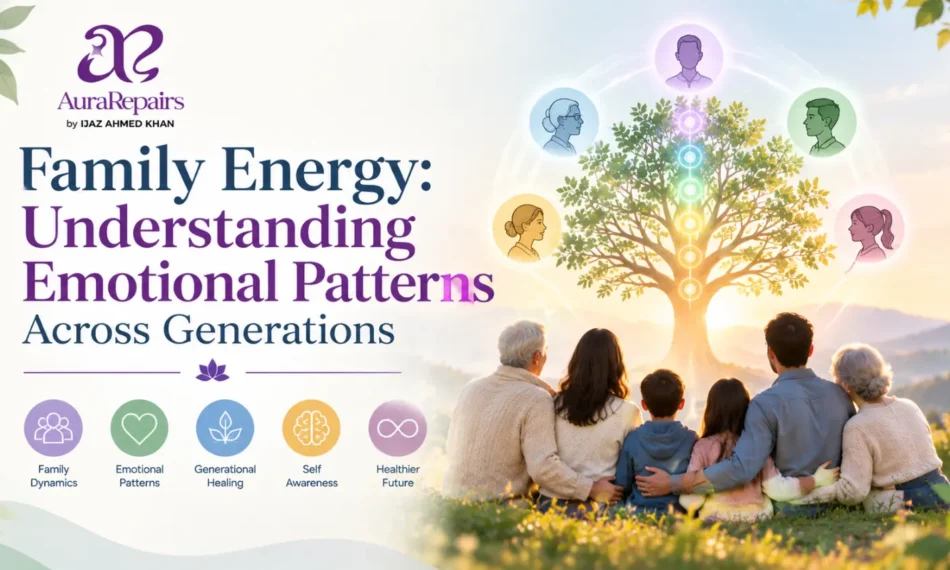
Have you ever noticed the same emotional struggles recurring across generations in your family? Perhaps your grandparents struggled to express affection, your parents avoided uncomfortable conversations, and you now recognise similar habits in your own relationships. Or perhaps your family has a long history of worry, conflict, emotional distance, or feeling responsible for everyone else’s happiness.
These experiences raise an important question: Can the emotional patterns we experience in our families influence how we feel, behave, and connect with others?
In spiritual wellness, family energy describes a family’s emotional atmosphere, sense of connection, and perceived energetic dynamics. Some people explore these experiences through aura healing and generational healing, using spiritual reflection to understand recurring patterns and develop a greater sense of inner balance.
From a psychological perspective, family behaviours can also be shaped by learned habits, parenting, communication styles, relationships, and shared life experiences. These explanations are different from spiritual beliefs about a family aura, but both can encourage thoughtful reflection on family relationships.
In this guide, we explore family energy patterns, how emotional experiences may carry across generations, and how aura healing and responsible spiritual practices can form part of a personal approach to family wellbeing.
What Is Family Energy in Aura Healing?
In spiritual wellness traditions, family energy refers to the atmosphere and perceived energetic connection shared by members of a household or family system. It may describe whether a home feels peaceful and supportive or tense, emotionally distant, and difficult to navigate.
For example, a household where family members listen to one another, communicate openly, and respect personal boundaries may feel emotionally supportive. A household characterised by unresolved disagreements, criticism, or unspoken worries may feel more stressful.
In aura healing traditions, practitioners may interpret these experiences through the lens of an individual’s aura or a family’s collective energy. Within this spiritual framework, aura healing and aura repair are intended to support reflection, balance, and a sense of harmony.
However, an aura is not a scientifically established measure of emotional health, and no reliable scientific evidence shows that a family shares an energy field that transmits emotional problems between relatives.
What can be explored more directly is how family members influence one another through communication, behaviour, expectations, and emotional responses. Understanding these connections can help people recognise patterns they would like to change.
How Do Emotional Patterns Pass Across Generations?
Emotional patterns can recur across generations when people learn similar ways of responding to stress, conflict, affection, and responsibility.
Children often observe how adults handle everyday difficulties. They may learn whether it is acceptable to express sadness, how disagreements are resolved, and what behaviour a parent, partner, or child is expected to show.
For instance, someone who grew up in a home where emotions were rarely discussed may learn to keep their feelings private. As an adult, they might struggle to explain their needs or become uncomfortable when a partner wants to discuss a difficult subject.
Similarly, a parent who experienced persistent uncertainty during childhood may become especially protective of their own children. Their intentions may be caring, even if their responses sometimes make it difficult for children to develop independence.
Research into intergenerational trauma and family relationships explores how difficult experiences can influence later generations through psychological, social, relational, and other pathways. The mechanisms are complex, and not every family member will experience the same outcomes.
This is an important distinction: recurring emotional patterns are not proof of inherited spiritual damage. Nor are they a guarantee that future generations will repeat the same experiences.
What Are the Common Signs of Unhealthy Family Energy Patterns?
People use the phrase unhealthy family energy in different ways. In spiritual language, it may describe a household that feels heavy or unsettled. In everyday terms, it may refer to recurring tension, communication difficulties, or a lack of emotional safety.
Some patterns worth reflecting on include:
1. Repeated Family Conflict
If small disagreements regularly become major arguments, it may be helpful to examine how family members communicate, manage frustration, and repair misunderstandings.
2. Difficulty Expressing Emotions
Some families have learned to hide sadness, avoid vulnerability, or treat emotional conversations as uncomfortable. Over time, this can make it harder for people to ask for support or understand one another.
3. Feeling Responsible for Everyone
You may feel responsible for keeping the family happy, even when other people’s choices are beyond your control. This pattern can make it difficult to establish healthy emotional boundaries.
4. Repeating Relationship Habits
A person may avoid conflict, become overly protective, withdraw during disagreements, or struggle to trust others. These behaviours can stem from past relationships and learned family habits.
5. A Persistent Sense of Tension at Home
Ongoing disagreements, unclear expectations, financial pressure, or unresolved concerns can contribute to a stressful home environment. Some people describe this experience as negative family energy.
These examples are opportunities for reflection, not a diagnostic checklist. They do not establish that a family has a damaged aura, inherited spiritual blockage, or a mental health condition.
How Can Aura Healing Relate to Generational Healing?
Generational healing is a broad term for efforts to understand and change patterns that recur within a family. The term can refer to different approaches, depending on the context.
In psychological settings, family-related work may involve counselling, developing healthier communication, exploring childhood experiences, and learning new ways to respond to stress.
In spiritual wellness, generational healing may include meditation, prayer, ancestral reflection, aura healing, or practices intended to support a sense of inner balance and connection.
Aura healing approaches often use concepts such as energy cleansing, aura repair, and energetic alignment. People may find these practices meaningful as part of their personal spiritual beliefs, reflection, or self-care routines.
However, it is important to keep expectations realistic. Spiritual aura healing has not been established as a treatment that removes inherited trauma, changes another family member’s behaviour, or cures psychological conditions.
A responsible approach to family aura healing should encourage self-awareness, personal choice, and constructive action. It should never require you to blame a parent, accuse a relative of carrying negative energy, or believe that you are destined to repeat painful experiences.
Five Ways to Support Family Energy Healing and Emotional Balance
Whether you approach family healing through spiritual practice, personal reflection, or practical relationship changes, the aim is to develop healthier ways of relating to yourself and others.
1. Recognise the Patterns You Want to Change
Begin by identifying one recurring behaviour that affects your relationships.
Ask yourself:
- What tends to happen when my family experiences stress?
- How were emotions handled when I was growing up?
- Do I find it difficult to ask for help or express my needs?
- Which family habits do I want to continue, and which would I prefer to change?
Writing down your observations can help you recognise patterns without immediately judging yourself or your relatives.
You do not need to uncover every detail of your family history. Start with the experiences that feel relevant to your current life.
2. Create Space for Honest Communication
Family members don’t always interpret the same situation the same way. One person may see silence as a way to avoid conflict, while another experiences it as rejection.
When it feels safe, try expressing your experience without assigning blame. For example, you might say, “I find it difficult when we stop talking after an argument. Can we agree on a way to return to the conversation calmly?”
Listen to other perspectives, but remember that communication requires willingness from everyone involved. You cannot make someone participate in a healthy conversation if they are unwilling or feel unsafe engaging.
3. Establish Healthy Emotional Boundaries
Family relationships can be close and meaningful without requiring you to take responsibility for every problem.
Healthy boundaries may involve limiting difficult conversations when emotions are running high, declining unreasonable requests, protecting personal time, or seeking space from repeated harmful behaviour.
Boundaries are not a punishment. They help clarify what you can offer while respecting your own needs.
If a family relationship involves abuse, intimidation, or a risk to your safety, prioritise safety and appropriate support rather than attempting to resolve the situation through spiritual practices alone.
4. Explore Spiritual Reflection and Aura Repair
If spirituality is meaningful to you, consider creating a quiet routine for prayer, meditation, journalling, or reflection.
Within an aura healing framework, these practices may be used to symbolise releasing old burdens, reconnecting with personal values, and setting an intention for healthier relationships.
For example, you might reflect on a family habit you no longer wish to repeat and choose one practical response to practise during the coming week. This combines spiritual meaning with an action you can observe and work on.
Aura repair is a spiritual wellness concept, not a scientifically verified process for repairing a measurable energy field. Any benefits you experience should be considered in the context of your overall wellbeing and circumstances.
5. Seek the Right Support When Patterns Feel Difficult to Change
Some family patterns are deeply rooted and difficult to address alone. If recurring conflict, anxiety, grief, or painful memories are affecting your everyday life, a qualified counsellor or mental health professional may help you explore these experiences.
Spiritual reflection can complement your work if it fits your beliefs, but it should not replace appropriate professional care.
Change can also begin with one person. You may not be able to change the entire family dynamic. Still, you can practise clearer communication, respond differently to conflict, and make decisions that support your own wellbeing.
How AuraRepairs Approaches Generational and Family Healing
AuraRepairs offers a Generational & Family Healing service described through its spiritual wellness approach, the Energetic Parasol. The service explores family relationships and perceived family energy patterns through aura-healing language and energetic alignment.
For people who value spiritual reflection, this may offer a framework for exploring family history, personal boundaries, and the atmosphere they want to encourage at home.
If you are considering a spiritual healing service, ask what a session involves, what it can reasonably offer, and whether it complements your existing support. Avoid providers who promise guaranteed results, claim to cure trauma, or discourage you from seeking appropriate healthcare.
Learn more about AuraRepairs’ Generational & Family Healing service.
The purpose of a responsible spiritual wellness approach should be to support reflection and personal agency—not to create fear about family members or make you feel that your family is permanently damaged.
Can You Break Unhealthy Family Energy Patterns?
Yes, recurring family behaviours can change. People can learn new communication skills, set healthier boundaries, seek support, and develop different ways to respond to difficult emotions.
Changing a pattern does not mean rejecting your family or blaming previous generations. Many behaviours develop in response to the circumstances people faced at the time. Understanding that context can create room for compassion while still recognising that certain habits need to change.
You may choose to preserve family traditions that provide connection, kindness, resilience, and a sense of belonging while leaving behind patterns that no longer serve you.
From a spiritual perspective, you may use aura healing or generational healing as a personal framework for reflection. From a practical perspective, lasting change depends on your choices, behaviours, support, and circumstances.
You are not required to repeat every pattern you learned. With awareness and appropriate support, you can build healthier relationships and create a more supportive environment for yourself and future generations.
Conclusion: Restoring Balance Through Family Energy Healing
Family energy is a spiritual wellness concept people use to describe a family’s emotional atmosphere and perceived connections. Emotional habits can also recur across generations through learned behaviour, relationships, parenting, and shared experiences.
Understanding these patterns helps you decide which habits to keep and which to change. Healthy communication, emotional boundaries, self-reflection, and professional support can all play a role in this process.
For those drawn to spiritual wellness, aura healing and aura repair may offer a complementary way to reflect on family relationships and personal balance. These practices should be approached with realistic expectations. They should not be presented as proven treatments for inherited trauma or mental health conditions.
To explore this spiritual perspective further, visit AuraRepairs’ Generational & Family Healing service to understand its approach and decide whether it aligns with your personal beliefs and wellbeing goals.
Healing family patterns is not about creating a perfect family. It is about building more awareness, healthier responses, and greater freedom to choose how you relate to others.


