



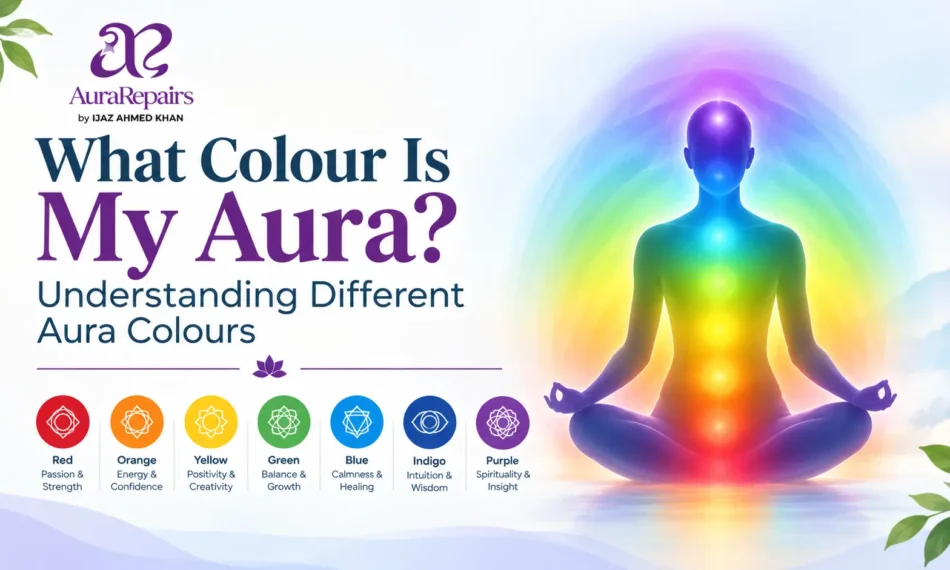
Have you ever wondered what colour your aura might be? Maybe you’re naturally drawn to blue, find comfort in green, or associate violet with spirituality and intuition. In aura healing traditions, colours often symbolise emotions, personal qualities, and spiritual growth.
An aura is described in spiritual traditions as a subtle energy field surrounding a person. Within these traditions, different aura colours are associated with qualities such as confidence, creativity, compassion, calmness, and spiritual awareness. These meanings vary between practitioners and are best understood as spiritual interpretations rather than scientific measurements of personality or health.
If you are asking, “What colour is my aura?”, this guide explains the traditional meanings of red, orange, yellow, green, blue, indigo, violet, pink, white, and gold. You will also discover how aura colours relate to chakra traditions and how aura healing, aura cleansing, and colour balancing may fit into a personal spiritual wellness routine.
What Is an Aura and What Do Aura Colours Mean?
In aura-based spiritual practices, the aura is understood as an energetic field associated with a person’s physical, emotional, and spiritual presence. Some practitioners believe they can perceive colours in this field and interpret them as symbols of a person’s current state or spiritual journey.
Aura colours do not have one universally accepted meaning. For example, a blue aura is commonly associated with calmness and communication. At the same time, green is often linked to growth, compassion, and harmony. Interpretations may differ depending on the spiritual tradition, the shade of the colour, and the practitioner’s approach.
It is also important to understand the scientific distinction. No reliable scientific evidence shows that auras exist as measurable coloured energy fields around people. Aura reading is therefore best treated as a spiritual or reflective practice, not a medical test or an objective assessment of character.
For someone exploring aura healing, the value may lie in using colour symbolism to reflect on personal feelings, intentions, and areas where greater balance is desired.
What Colour Is My Aura? Understanding the Main Aura Colours
The following interpretations are common in modern aura-reading traditions. They are not fixed rules, and no colour should be used to label a person as good, bad, healthy, unhealthy, or spiritually advanced.
Red Aura Meaning: Passion, Strength and Grounding
A red aura is commonly associated with vitality, determination, courage, passion, and a connection to the physical world. In chakra-based systems, red is traditionally linked to the root chakra, which symbolises grounding, stability, and security.
In a reflective context, red may invite you to consider how you use your motivation and respond to challenges. Are you pursuing an important goal? Do you feel grounded in your decisions? Are you balancing ambition with patience?
Aura healing practices that use red symbolism may focus on grounding, steady routines, and reconnecting with personal priorities. These practices should not be interpreted as a way to diagnose anger, blood pressure problems, or other health conditions.
Orange Aura Meaning: Creativity and Emotional Expression
Orange often represents creativity, enthusiasm, sociability, and emotional expression. It is commonly linked with the sacral chakra in traditions that map colours to energy centres.
People who feel drawn to orange may use it as a prompt to explore creative interests, relationships, and how comfortably they express their feelings.
For example, you might reflect on whether you have made enough space for enjoyable activities or whether you tend to hold back your ideas. Creative hobbies, journalling, movement, or meaningful conversations can provide practical ways to explore these themes.
In aura healing, orange may symbolise renewed enthusiasm and a more balanced relationship with personal expression. It does not establish that a person has a particular personality or emotional condition.
Yellow Aura Meaning: Confidence, Optimism and Clarity
Yellow is traditionally associated with optimism, curiosity, confidence, mental clarity, and personal initiative. In the chakra colour system, it is commonly connected with the solar plexus chakra, often used as a symbol of confidence and personal agency.
If yellow resonates with you, consider how you approach decisions and express your abilities. Are you giving yourself room to learn? Do you recognise your achievements, or do you focus mainly on what remains unfinished?
Colour-based reflection can encourage you to set realistic goals, recognise your strengths, and approach challenges with a more constructive mindset.
Within spiritual colour balancing, yellow may represent the intention to strengthen confidence and clarity. However, an aura colour cannot reveal intelligence, measure mental energy, or diagnose a physical condition.
Green Aura Meaning: Compassion, Growth and Harmony
Green is often linked to the heart chakra and symbolises compassion, renewal, growth, and connection with others. In aura-reading traditions, it is sometimes associated with people who value relationships, nature, and personal development.
Green can also prompt you to consider the balance between caring for others and caring for yourself. Do you offer support while respecting your own limits? Are you making time to recover after emotionally demanding situations?
From an aura healing perspective, green may represent an intention to cultivate harmony, self-compassion, and healthier boundaries.
These are reflective associations rather than verified personality traits. A green aura reading cannot establish whether someone is naturally nurturing, emotionally balanced, or experiencing a particular health issue.
Blue Aura Meaning: Calmness, Honesty and Communication
A blue aura is commonly associated with calmness, communication, honesty, and thoughtful expression. In traditional chakra colour mappings, blue is linked with the throat chakra, which symbolises communication and speaking authentically.
If blue is a colour you identify with, reflect on how you communicate your needs, listen to others, and handle difficult conversations.
For example, a person who avoids expressing disagreement may use blue as a reminder to communicate more clearly and respectfully. Someone who frequently feels overwhelmed by conversations may focus on listening carefully and taking time before responding.
Aura cleansing and spiritual reflection practices may use blue as a symbol of peace and clarity. However, the colour itself cannot verify a person’s communication skills or indicate their physical or emotional health.
Indigo Aura Meaning: Intuition and Inner Awareness
Indigo is a deep blue-purple shade traditionally associated with intuition, introspection, imagination, and inner awareness. In chakra-based traditions, it is commonly connected with the third-eye chakra.
If indigo resonates with you, consider how you make decisions and process experiences. Do you allow time to think before acting? Can you distinguish a useful instinct from an assumption that needs further evidence?
Meditation, quiet reflection, and journalling can help you explore these questions. They may also help you distinguish between a feeling, a belief, and something you know to be true.
In aura healing traditions, indigo can symbolise a deeper connection with inner reflection. It should not be treated as proof of psychic abilities or a guarantee that an intuition is correct.
Violet or Purple Aura Meaning: Spirituality and Imagination
Violet, sometimes described as purple, often represents spiritual exploration, imagination, wisdom, and personal transformation. In many chakra colour systems, violet is linked with the crown chakra, a symbol of spiritual connection and a broader sense of meaning.
People drawn to violet may use the colour to reflect on their values, beliefs, and relationship with the wider world.
Spiritual practices such as prayer, meditation, reading, or quiet contemplation can help you make space for these questions if they fit your beliefs.
Within aura healing, violet may represent an intention to deepen self-awareness and explore spiritual growth. It does not establish a person’s level of spiritual development, nor does it indicate a medical or psychological condition.
Do Aura Colours Change Over Time?
In many spiritual traditions, aura colours are thought to change as a person’s experiences, emotions, intentions, or spiritual interests change.
For example, someone might associate green with personal growth or blue with a desire to communicate more calmly. These interpretations can be meaningful as personal symbolism, but no established scientific method measures changes in a spiritual aura.
You do not need to identify a new aura colour every time your mood changes. Emotions naturally vary, and a difficult day doesn’t mean your aura is damaged or that you need urgent spiritual repair.
If colour symbolism helps you reflect, use it as a starting point for questions about your wellbeing rather than as a judgement about yourself.
How Are Aura Colours Connected to Chakras?
Chakras are energy centres described in several Indian spiritual and philosophical traditions. Modern chakra-based practices often associate particular colours with seven main centres:
- Root chakra — red: grounding and stability.
- Sacral chakra — orange: creativity and expression.
- Solar plexus chakra — yellow: confidence and personal agency.
- Heart chakra — green: compassion and connection.
- Throat chakra — blue: communication and expression.
- Third-eye chakra — indigo: intuition and reflection.
- Crown chakra — violet or white: spiritual connection and broader awareness.
These colour associations are part of spiritual frameworks, and interpretations can vary between traditions. Chakras and aura colours are not scientifically validated anatomical structures or diagnostic tools.
How Can Aura Healing and Colour Balancing Support Your Spiritual Practice?
Aura healing is a broad term for spiritual practices intended to support balance, reflection, or connection with one’s inner life. Practitioners may use aura cleansing and aura repair to describe their approaches.
If you find colour symbolism meaningful, you can incorporate it into a simple personal routine:
- Choose a reflection theme. Select a colour whose traditional symbolism resonates with an area of your life you want to explore.
- Identify a practical intention. For example, use blue to remind you to communicate clearly, or green to help you maintain healthy boundaries.
- Make space for reflection. Consider journalling, prayer, meditation, or another quiet practice that fits your beliefs.
- Take a real-world action. Have a needed conversation, establish a boundary, make time for rest, or seek support when appropriate.
- Review what you learn. Focus on your experiences and choices rather than trying to prove that a colour has changed.
Aura healing is not a scientifically established way to repair a measurable energy field, treat illness, or guarantee changes in relationships or life circumstances.
Exploring Colour & Frequency Balancing at AuraRepairs
AuraRepairs offers a Colour & Frequency Balancing service as part of its spiritual wellness approach. The service uses the language of aura colours, perceived energetic balance, and personal alignment to frame its work.
If you are considering a session, ask what the process involves, how the practitioner interprets colour symbolism, what outcomes are realistic, and how the service fits alongside other support you may need.
Learn more about Colour & Frequency Balancing at AuraRepairs.
Treat the service as a spiritual wellness option, not as a replacement for medical advice, psychological support, or evidence-based treatment.
Final Thoughts: What Colour Is Your Aura?
So, what colour is your aura? In spiritual aura-reading traditions, red is associated with grounding and vitality, orange with creativity, yellow with confidence, green with compassion, blue with communication, indigo with intuition, and violet with spiritual reflection. Pink, white, and gold also have their own symbolic associations.
These interpretations are not universal, and no colour can objectively define your personality, health, or spiritual development. Their value depends on how thoughtfully you use them.
If aura colours inspire you, let them encourage self-awareness rather than worry. Aura healing, aura cleansing, and colour balancing may offer a personal framework for reflection when approached with realistic expectations.
To explore this approach further, visit AuraRepairs’ Colour & Frequency Balancing service and learn how its spiritual wellness framework may fit your interests and personal beliefs.
The most useful question may not be which colour describes you perfectly, but what you can learn about yourself—and what positive step you would like to take next.


