



Life can change unexpectedly. Difficult relationships, career setbacks, financial pressure, uncertainty, loss, and everyday responsibilities can test our ability to stay grounded and move forward.
Building resilience does not mean avoiding difficult experiences or pretending that everything is fine. Resilience is the ability to adapt to challenges, learn from experiences, and continue moving forward while giving yourself space to process what you are going through.
With practical coping strategies, self-awareness, healthy routines, supportive relationships, and meaningful spiritual practices, you can gradually develop greater inner resilience and emotional balance.
Sometimes resilience means taking a bold step forward. At other times, it simply means pausing, asking for support, and taking the next small step.
What Is Resilience?
Resilience is the ability to adapt when life becomes challenging. It involves recognising difficult emotions, adjusting to change, making thoughtful choices, and finding constructive ways to move forward.
Being resilient does not mean you will never feel disappointed, worried, frustrated, or overwhelmed. Instead, it means developing practical ways to respond to difficult situations without allowing temporary setbacks to define your entire life.
Resilience can also develop through experience. Each time you navigate a difficult situation, reflect on what happened, and discover a healthier way to respond, you may gain a better understanding of your own strengths and coping patterns.
Why Is Building Resilience Important?
Life’s challenges are unavoidable, but our response to them can develop over time. Building resilience can help you approach uncertainty with greater awareness rather than reacting immediately out of fear, frustration, or self-doubt.
A resilient mindset can encourage you to focus on what you can control, recognise your available choices, and seek appropriate support when necessary. It can also help you recover your sense of direction after a setback.
Resilience is therefore not about becoming emotionally unaffected. It is about becoming better prepared to face change while maintaining your connection to your values, relationships, and sense of purpose.
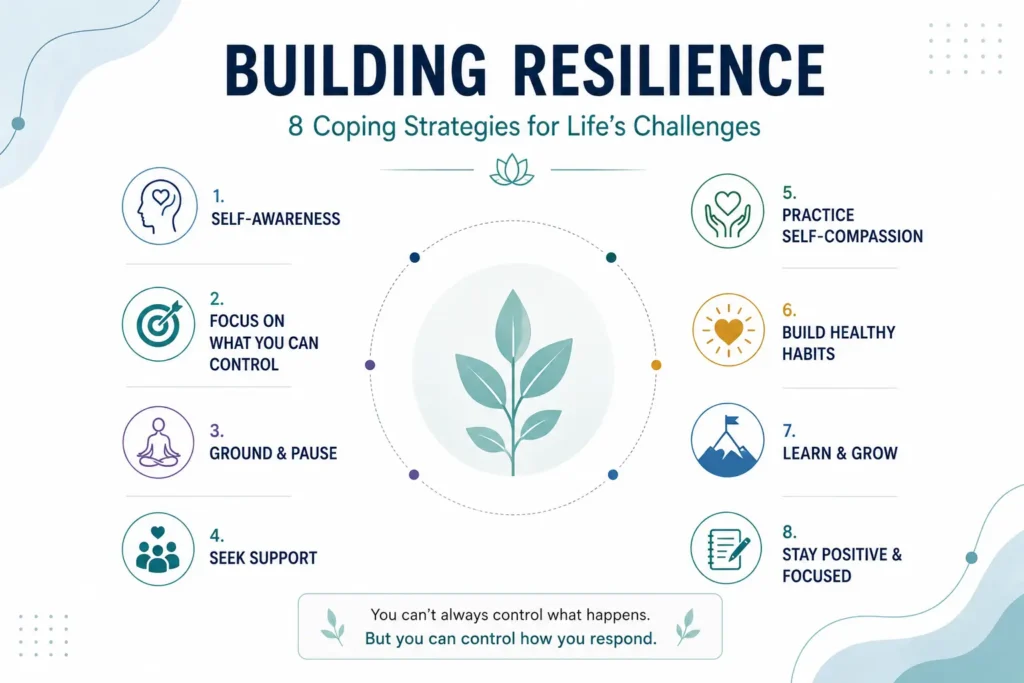
8 Practical Coping Strategies for Life’s Challenges
Focus on What You Can Control
When life feels uncertain, it is easy to spend energy thinking about situations, people, or outcomes you cannot control. This can make a difficult situation feel even more overwhelming.
Instead, identify the part of the situation that is within your influence. Ask yourself, “What is one useful action I can take today?” Focusing on the next practical step can help you regain a sense of direction.
Practice Self-Awareness
Self-awareness is an important part of building emotional resilience. Understanding your thoughts, emotions, triggers, and reactions can help you recognise patterns before they influence your decisions.
Try spending a few minutes each day reflecting on what you experienced. Journaling can be particularly useful because writing down your thoughts can help you identify recurring concerns, personal values, and areas where you may need healthier boundaries.
Develop a Grounding Routine
A grounding routine can create a regular opportunity to slow down and reconnect with the present moment. Simple practices may include quiet reflection, mindful breathing, prayer, meditation, spending time outdoors, or taking a break from unnecessary digital stimulation.
You do not need an elaborate routine. Even a few intentional minutes each day can provide a valuable pause between facing a challenge and deciding how you want to respond.
Build Supportive Relationships
Resilience does not mean handling every problem alone. Supportive relationships can provide encouragement, perspective, companionship, and a safe space to express what you are experiencing.
Consider maintaining connections with people you trust and feel comfortable talking to. When a challenge becomes difficult to manage on your own, reaching out for appropriate personal, professional, or community support can be an important part of coping.
Practice Self-Compassion
Setbacks often trigger harsh self-criticism. You may find yourself thinking that you should have made a better decision, handled a situation differently, or recovered more quickly.
Self-compassion means allowing yourself to acknowledge mistakes and difficult emotions without turning them into negative judgments about your entire identity. Ask yourself what you would say to a trusted friend facing the same situation, and consider offering yourself the same understanding.
Create Healthy Daily Habits
Resilience is strengthened through consistent everyday choices. Adequate rest, balanced nutrition, physical activity, meaningful social connection, and time for relaxation can help create a more stable foundation for dealing with life’s demands.
Rather than trying to change everything at once, choose one realistic habit. A consistent routine is easier to maintain than an unrealistic plan that creates additional pressure.
Learn From Difficult Experiences
Not every difficult experience needs to be viewed as a lesson immediately. Some situations require time, acceptance, and emotional processing.
When you feel ready, however, reflection can help you understand what an experience taught you about your boundaries, priorities, relationships, expectations, or personal values. Ask, “What do I want to carry forward from this experience?”
Make Time for Spiritual Reflection
For people who value spirituality, spiritual practices can provide an opportunity to reflect on personal values, purpose, gratitude, and inner awareness.
Prayer, meditation, spiritual guidance, quiet reflection, and energy-based wellness practices may become part of a personal routine for those who find them meaningful. These practices should be viewed as complementary wellness approaches rather than as replacements for appropriate medical or mental health care.
How to Cope With Life’s Challenges One Step at a Time
When several problems happen together, trying to solve everything immediately can increase feelings of pressure. Breaking a challenge into smaller and more manageable steps can make it easier to decide what deserves your attention first.
Start by identifying the most immediate issue. Then ask what information, decision, action, or support you need to take the next step. You do not have to know exactly how everything will turn out before moving forward.
How to Develop a Resilient Mindset
A resilient mindset begins with realistic thinking. Instead of assuming that a difficult moment will continue forever, remind yourself that circumstances can change and that you can adapt as new information becomes available.
It can also help to replace all-or-nothing thinking with more balanced questions. Rather than asking, “Why does everything go wrong for me?”, consider asking, “What is difficult right now, and what can I do about the part I can influence?”
Over time, these small changes in perspective can encourage greater self-awareness and flexibility.
The Role of Self-Reflection in Resilience
Self-reflection allows you to look beyond the immediate difficulty and understand what may be happening beneath the surface. You can explore your reactions, expectations, fears, boundaries, and personal values without immediately judging them.
Try keeping a simple resilience journal. At the end of the day, write down one challenge you faced, how you responded, what you learned, and one thing you can approach differently next time.
Can Spiritual Guidance Support Personal Resilience?
For individuals who incorporate spirituality into their lives, spiritual guidance can provide a structured opportunity for reflection and personal exploration. It may help someone think more deeply about their values, experiences, relationships, and sense of direction.
At Aura Repair, spiritual wellness services such as aura reading, energy-based practices, and spiritual guidance are approached as opportunities for personal reflection and wellbeing. They are not intended to diagnose or treat medical or mental-health conditions.
A Simple Daily Resilience Practice
You can begin developing resilience with a simple five-minute routine. Sit quietly, take a few comfortable breaths, and identify one thing that is currently within your control.
Then ask yourself three questions: What am I feeling? What do I need? What is my next constructive step? Write down your answer if doing so helps you think more clearly.
At the end of the day, identify one thing you handled well and one thing you learned. The purpose is not to judge yourself but to gradually develop greater awareness of how you respond to life’s challenges.
When Should You Seek Additional Support?
Resilience does not mean that you should handle serious or persistent difficulties without help. If a situation is significantly affecting your daily functioning, relationships, safety, or overall wellbeing, consider speaking with an appropriately qualified professional.
Friends, family members, mentors, community resources, counsellors, and healthcare professionals can all play different roles in providing support. Spiritual or wellness practices may complement a person’s personal routine, but they should not replace appropriate professional care.
Final Thoughts
Building resilience is a gradual process. You do not need to become unaffected by difficult experiences or have every answer before you can move forward.
Start with what is possible today. Focus on what you can control, develop healthy coping strategies, reflect on your experiences, maintain supportive relationships, and make space for practices that bring greater awareness and meaning to your life.
Life will continue to bring unexpected changes and obstacles. Inner resilience can help you meet those experiences with greater patience, flexibility, and self-awareness.


