



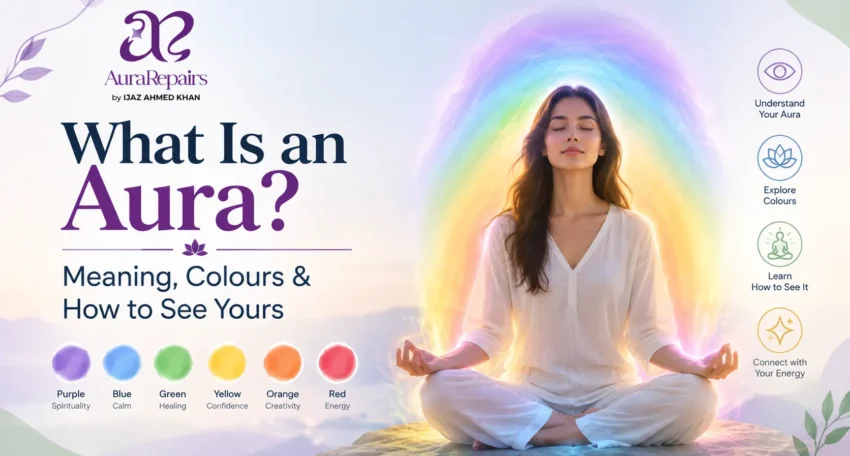
Have you ever wondered, “What is an aura?” or why some people seem to have a certain energy or presence around them? In spiritual and holistic traditions, an aura is commonly described as an energetic field surrounding a person. People who practice aura healing and energy work may interpret this field as reflecting aspects of a person’s emotional, spiritual, and energetic state.
Aura colours are also widely discussed in spiritual practices. Different colours are traditionally associated with different qualities, emotions, or forms of energy. Learning about aura colours can help you explore self-awareness, personal reflection, and spiritual well-being.
The aura described in spiritual practices is a spiritual concept, not a scientifically established physical structure. Aura healing should be viewed as a complementary spiritual practice and not as a replacement for medical or mental-health care.
In this guide, we explain what an aura means, what aura colours may represent, how to see your aura, how to find your aura colour, and how aura healing may fit into a personal wellness journey.
What Is an Aura?
An aura is traditionally described as an energy field surrounding the human body. Different spiritual and holistic traditions interpret what an aura represents and how it can be perceived.
In aura healing practices, the aura may be viewed as a reflection of a person’s emotional and energetic condition. Someone may describe themselves as feeling calm, balanced, positive, drained, heavy, or emotionally overwhelmed. In spiritual traditions, these experiences are sometimes described as changes or imbalances in the aura.
The concept of an aura is also connected with the familiar idea of someone’s “energy” or “presence.” For example, you might meet someone who immediately makes you feel comfortable and calm. In contrast, another person or environment may feel emotionally intense.
For people interested in spiritual healing, understanding the idea of an aura can provide a framework for self-reflection, emotional awareness, and energetic well-being.
What Does Aura Mean?
The word aura can have different meanings depending on the context.
In everyday language, aura can describe a distinctive feeling, atmosphere, or quality associated with a person, place, or situation.
In spiritual practices, an aura is generally understood as an energetic field surrounding a person. Some traditions associate different aspects of the aura with emotions, personality, spiritual awareness, or overall energetic balance.
This is why people commonly search for questions such as:
- What does aura mean?
- What is an aura?
- What is aura meaning?
- What are aura colours?
- What does my aura mean?
- What colour is my aura?
Answers can vary depending on the spiritual tradition or practitioner you follow.
What Are Aura Colours?
One of the most popular parts of aura reading is interpreting aura colours.
According to various spiritual traditions, an aura may be described in different colours, with each colour associated with particular qualities or emotional themes. Some people believe aura colours can change depending on a person’s emotions, experiences, or energetic state.
No single universal system exists for interpreting aura colours. Meanings vary across spiritual traditions and practitioners.
Commonly discussed aura colours include:
Red Aura
A red aura is traditionally associated with energy, passion, strength, determination, and physical vitality.
In some spiritual interpretations, a strong red presence may be connected with confidence and motivation. In contrast, an intense or unsettled red may be interpreted as emotional tension or restlessness.
Orange Aura
Orange is often associated with creativity, enthusiasm, emotional expression, and social energy.
People who interpret aura colours may connect orange with a desire to create, communicate, explore, and experience life more actively.
Yellow Aura
A yellow aura is commonly associated with optimism, confidence, happiness, creativity, and mental energy.
In spiritual interpretations, yellow may represent bright, expressive energy. Some people associate it with curiosity, learning, and a positive outlook.
Green Aura
Green is often connected with growth, harmony, compassion, balance, and emotional healing.
Because green is strongly associated with nature, many spiritual traditions use it symbolically when discussing balance, renewal, and emotional development.
Blue Aura
A blue aura is commonly associated with calmness, communication, truth, intuition, and emotional depth.
Some aura-reading traditions interpret lighter blues as peaceful or gentle energy. At the same time, deeper shades may be associated with introspection and communication.
Purple Aura
Purple is frequently associated with spiritual awareness, intuition, imagination, and personal transformation.
People interested in spiritual development may find purple particularly meaningful because it is often connected with higher awareness and inner exploration.
How Are Aura Colors and Energy Centres Connected?
Aura colours and energy centres are related concepts in many spiritual and energy-healing traditions. Still, they are not the same thing. Aura colours are traditionally interpreted as qualities or energetic themes surrounding a person. Energy centres, by contrast, are specific areas of the body’s energetic system.
In many chakra-based practices, seven major energy centres are commonly discussed, each associated with different aspects of physical, emotional, and spiritual experience:
- Root: Traditionally associated with grounding, stability, safety, and connection.
- Sacral: Linked with creativity, emotions, relationships, and personal expression.
- Solar Plexus: Associated with confidence, motivation, personal power, and self-esteem.
- Heart: Connected with compassion, love, emotional balance, and connection with others.
- Throat: Traditionally associated with communication, truth, and self-expression.
- Third Eye: Linked with intuition, inner awareness, insight, and spiritual perception.
- Crown: Associated with spiritual connection, higher awareness, consciousness, and inner peace.
From a spiritual perspective, practitioners may consider both aura colours and energy centres when exploring a person’s energetic experience. For example, an aura reading may focus on perceived colours or patterns. At the same time, chakra-focused practices may explore specific energy centres.
These interpretations vary between traditions and practitioners and are best understood as spiritual or complementary wellness practices rather than scientifically established measurements. Exploring aura colours and energy centres can nevertheless provide a framework for self-reflection, mindfulness, and spiritual growth.
Can Your Aura Colour Change?
Many spiritual traditions believe that aura colours can change over time.
According to this perspective, your emotional experiences, personal growth, stress levels, relationships, and spiritual practices may influence how your energy is perceived.
For example, someone may feel emotionally exhausted during a difficult period and later feel more peaceful and positive after making lifestyle changes or working through personal challenges.
However, don’t treat aura colours as a medical diagnosis or a scientifically validated measure of your physical or mental health.
Instead, you can use aura colours as a tool for personal reflection and spiritual exploration.
How Do You Find Your Aura Colour?
If you are asking “What colour is my aura?”, there are several spiritual approaches you may encounter.
Some people use meditation and intuitive practices, while others work with aura readers or energy-healing practitioners.
Rather than focusing only on one colour, a practitioner may consider the broader context of your emotional experiences, personal concerns, and spiritual goals.
This can make aura exploration more meaningful because the purpose isn’t simply to receive a colour label. It can also encourage you to think about:
- How you currently feel
- What emotions you experience most often
- Whether you feel mentally or emotionally drained
- What areas of your life feel balanced
- Where you want greater clarity
- What personal changes you would like to make
For many people, this type of reflection is one of the most valuable aspects of exploring their aura.
What Is Aura Healing?
Aura healing is a spiritual or holistic practice focused on energetic balance, personal reflection, and spiritual well-being.
Depending on the practitioner, aura healing may involve energy work, spiritual guidance, aura cleansing, chakra-related practices, meditation, visualization, or other approaches.
The goal may be to help a person feel more balanced, grounded, clear, or connected with themselves.
Aura healing is not a substitute for professional medical or mental-health treatment. If you have persistent physical symptoms, severe anxiety, depression, or another health concern, seek appropriate professional care.
What Is Aura Diagnostic & Mapping?
Aura Diagnostic & Mapping is one approach offered by Aura Repairs for people who want to explore their energetic experience in a more structured way.
The service is presented as a way to understand areas of perceived energetic imbalance and develop a personalized approach based on the individual’s concerns.
This type of session can be especially helpful if you are unsure which aura healing or energy-balancing service is right for you.
Rather than trying to identify everything yourself, you can discuss your concerns and explore your experiences with a practitioner.
How Are Aura Healing and Energy Balancing Connected?
Aura healing and energy balancing are often discussed together because both focus on restoring energetic harmony.
People may explore these practices when they feel emotionally overwhelmed, mentally scattered, disconnected from themselves, or simply interested in spiritual self-development.
At Aura Repairs, energy-related services include Aura Diagnostic & Mapping, Aura Cleansing & Repair, Chakra Healing & Alignment, Energy Healing, Colour & Frequency Balancing, and spiritual guidance.
The appropriate approach depends on the individual’s goals and the practitioner’s assessment.
Can Stress Affect Your Aura?
From a spiritual perspective, many people believe that prolonged stress can influence their energetic balance.
Stress can also affect everyday life, including sleep, concentration, mood, relationships, and overall well-being. Within spiritual traditions, experiences such as emotional heaviness, feeling drained, or feeling disconnected may sometimes be described as an energetic imbalance.
This does not mean that stress literally damages a scientifically measurable aura.
Healthy responses to stress can include adequate sleep, physical activity, relaxation, healthy boundaries, mindfulness, supportive relationships, and professional help when needed.
People who value spiritual practices may use meditation, prayer, energy work, or aura healing alongside these healthy habits.
When Should You Explore Aura Healing?
You may be interested in aura healing if you want to:
- Learn more about your personal energy
- Explore aura colours and their traditional meanings
- Develop greater self-awareness
- Reflect on emotional or spiritual experiences
- Explore energy-balancing practices
- Learn about aura cleansing
- Receive personalized spiritual guidance
- Understand your perceived energetic patterns
You don’t need to believe an aura is a scientifically measurable structure to approach the subject thoughtfully. For some people, it is primarily a spiritual framework for reflection and personal growth.
Aura Healing Sessions With Aura Repairs
If you want to explore what an aura is, how aura colours are interpreted, or how aura healing works, Aura Repairs offers personalized spiritual and energy-focused services.
Aura Repairs, led by Ijaz Ahmed Khan, offers services including Aura Diagnostic & Mapping, Chronic Stress & Burnout Repair, Negative Entity & Nazar Clearance, Colour & Frequency Balancing, Corporate Aura Alignment, and Generational & Family Healing.
Remote or online sessions are also available so that you can explore spiritual guidance and energy-healing practices from different locations.
The best starting point can depend on your individual goals. If you are unsure which service is right for you, an initial discussion or diagnostic-focused session can help you understand the available options.
Final Thoughts
So, what is an aura?
In spiritual and holistic traditions, an aura is commonly described as an energetic field surrounding a person. Aura colours are traditionally interpreted as symbolic representations of qualities, emotions, or energetic states. However, meanings vary across traditions and aren’t scientifically standardized.
Learning about your aura can help you explore self-awareness, emotional balance, spiritual well-being, and personal growth.
If you want to understand your aura colour, learn how to read auras, or explore aura cleansing and energy balancing, start with an open, thoughtful approach. Focus on practices that support your overall well-being, and remember that spiritual healing should complement—not replace—appropriate medical or mental-health care.


