


Have you ever noticed that certain emotional patterns, relationship dynamics, fears, or behaviors repeat within a family? Perhaps several generations have experienced similar struggles, communication styles, relationship difficulties, or ways of dealing with stress.
These observations often lead people to ask: Can family patterns be passed from one generation to another? And more specifically, what is generational healing?
Generational healing is a broad term used in spiritual and wellness communities to describe the process of becoming aware of patterns that appear to move through a family and working toward healthier ways of relating, coping, and living.
The concept can overlap with established ideas such as intergenerational trauma, family systems, learned behaviors, attachment patterns, and family relationships. Spiritual approaches may additionally describe these experiences in terms of ancestral energy, family energy, or inherited energetic patterns.
Understanding the difference between these perspectives is important. Generational healing can be explored as a reflective or spiritual wellness practice. At the same time, mental health conditions and trauma-related concerns should be addressed with appropriately qualified healthcare or mental health professionals.
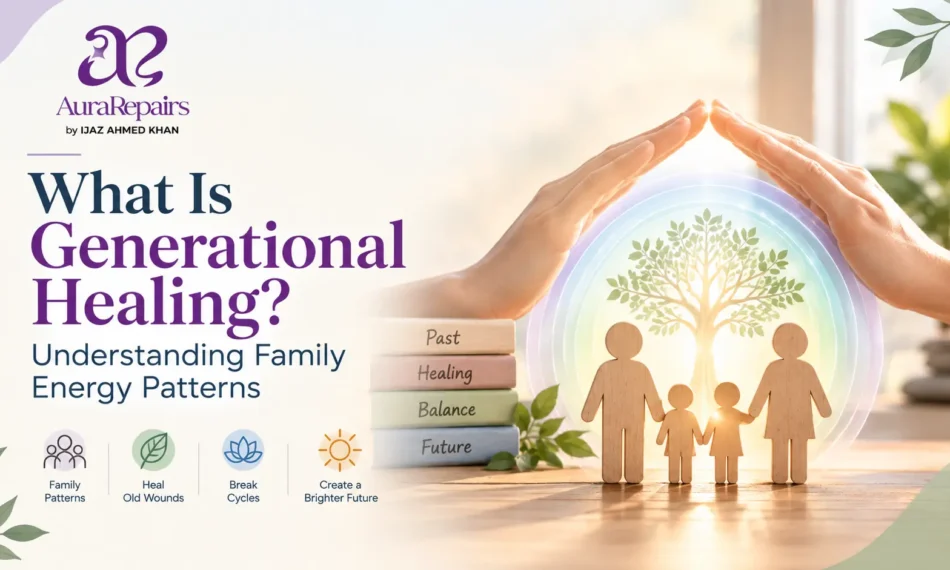
What Is Generational Healing?
Generational healing is the process of identifying, understanding, and consciously changing unhealthy patterns that may have developed within a family and continued across generations.
In a spiritual context, generational healing may involve exploring what practitioners describe as family energy patterns or ancestral energy. These approaches may view unresolved experiences, beliefs, emotions, or relationship patterns as influencing later generations.
From a psychological and family-systems perspective, patterns can also develop through family relationships, learned behaviors, attachment, communication styles, cultural influences, and responses to stressful or traumatic experiences.
For example, a family may develop a pattern of avoiding difficult conversations. Children may learn this communication style from parents, and later repeat it in their own relationships.
Generational healing focuses on bringing these patterns into awareness rather than repeating them automatically.
What Is Intergenerational Trauma?
Intergenerational trauma refers to the ways the effects of severe or traumatic experiences can influence later generations.
Research and clinical discussions have explored several possible pathways, including family relationships, learned behaviors, attachment, social conditions, and biological mechanisms. Research on family systems also considers how anxiety and relationship patterns can reverberate across generations.
For example, a parent who experienced significant trauma may become extremely protective of their children. That behavior may come from a desire to keep the family safe, but it can sometimes influence how children understand danger, independence, and relationships.
It is important to remember that intergenerational trauma is not the same thing as spiritual “negative energy.” They are different frameworks for understanding family experiences.
Generational healing may incorporate spiritual reflection, while trauma-related concerns may require professional psychological or therapeutic support.
How Do Family Patterns Pass From One Generation to Another?
No single explanation explains why family patterns repeat. Several influences can interact.
Learned Behaviours
Children observe how parents and caregivers communicate, manage conflict, respond to stress, and express emotions.
Over time, these behaviors can become familiar patterns.
Family Communication
Families develop their own communication styles. Some encourage open conversations, while others avoid difficult subjects.
A pattern of silence can sometimes continue across generations unless someone consciously chooses a different approach.
Attachment and Relationships
Early relationships can influence how people understand trust, closeness, boundaries, and emotional security.
These relationship patterns can affect later family interactions.
Cultural and Social Influences
Family traditions, cultural expectations, migration experiences, economic circumstances, and community environments can influence beliefs and behaviors across generations.
Experiences of Trauma or Loss
Major experiences such as displacement, bereavement, violence, discrimination, conflict, or severe hardship can influence family dynamics long after the original event.
These influences do not mean that a person is destined to repeat their family’s past. Awareness and supportive interventions can help people develop healthier patterns.
What Are Signs of Repeating Family Patterns?
No universal checklist proves a family has a generational pattern. However, people may notice recurring themes such as:
- Similar relationship difficulties across generations
- Repeated communication problems
- Difficulty expressing emotions
- Persistent conflict between family members
- Strong fear around particular situations
- Repeated patterns of people-pleasing
- Difficulty establishing healthy boundaries
- Similar approaches to handling stress
- Family beliefs that discourage emotional openness
- Repeated patterns of avoidance or emotional withdrawal
Recognizing one of these patterns does not mean that a person has inherited a problem.
Instead, it can be an invitation to ask:
“Where did I learn this pattern, and is it still helping me today?”
That question can be a powerful starting point for personal reflection.
What Does Healing Generational Patterns Mean?
Healing generational patterns means becoming more conscious of behaviors, beliefs, emotional responses, and relationship dynamics that may have been repeated within a family—and choosing healthier responses where possible.
This does not mean blaming parents, grandparents, or previous generations.
Many family patterns developed because people were trying to survive difficult circumstances with the resources available to them.
For example, emotional silence may have helped someone cope with a challenging environment. However, the same pattern may become unhelpful when passed into a family that needs open communication.
Healing can therefore involve understanding the original pattern while deciding what should—and should not—continue.
What Is Ancestral Healing?
Ancestral healing is a spiritual concept that focuses on reflection, connection, and perceived relationships with previous generations.
Some spiritual practitioners believe that unresolved experiences or energetic patterns can affect descendants. Practices may include meditation, prayer, intention-setting, reflection, symbolic rituals, family storytelling, or energy-based approaches.
These practices can have personal or cultural meaning for people who choose them. However, treat claims that ancestral healing can scientifically remove inherited illness, trauma, or specific medical conditions with caution.
A balanced approach is to recognize ancestral healing as a spiritual or complementary wellness practice, not a substitute for medical or psychological care.
How Can You Start Healing Family Patterns?
You do not have to understand your entire family history before beginning personal reflection.
Here are some practical starting points.
1. Identify Repeating Patterns
Think about behaviors or beliefs that keep repeating in your family.
Ask yourself:
- What keeps repeating?
- How do family members usually respond to conflict?
- What emotions are difficult to express?
- Which beliefs about relationships were passed down to me?
2. Learn Your Family Story
Where appropriate and emotionally safe, talking with relatives can help you understand family history.
You may discover experiences that provide context for behaviors you previously found difficult to understand.
3. Notice Your Own Responses
Pay attention to situations where your emotional response feels particularly strong.
Rather than judging yourself, consider whether the reaction connects to a familiar family pattern.
4. Develop Healthier Boundaries
Healing family patterns does not always mean changing other people.
Sometimes it means learning how to communicate clearly, establish healthy boundaries, and make different choices in your own life.
5. Seek Appropriate Support
If family experiences involve significant trauma, abuse, grief, anxiety, depression, or other mental health concerns, consider speaking with a qualified mental health professional.
Spiritual practices can complement professional care, but they should not replace it.
Can You Break Generational Cycles?
Yes, people can work toward breaking generational cycles by recognizing patterns and making conscious changes.
Breaking a cycle does not necessarily mean rejecting your family or ending relationships.
It can mean:
- Communicating differently
- Setting healthier boundaries
- Responding rather than reacting
- Learning healthier coping strategies
- Challenging inherited beliefs
- Building supportive relationships
- Seeking professional help when needed
- Creating a different emotional environment for future generations
In this sense, becoming a “cycle breaker” can mean creating more choice.
You may not be able to change what happened in previous generations, but you can work on how those experiences influence your choices today.
Generational Healing From a Spiritual Perspective
For people who follow spiritual wellness practices, generational healing may offer another framework for reflecting on family history and personal identity.
A spiritual approach may explore concepts such as:
- Ancestral energy
- Family energy
- Emotional energy
- Energy cleansing
- Spiritual healing
- Inner balance
- Ancestral patterns
- Family healing
- Energy alignment
The purpose can be to encourage reflection, intention, compassion, and personal growth.
At the same time, it is important not to describe spiritual concepts as scientifically proven explanations for psychological or medical conditions.
A responsible spiritual wellness approach recognizes the difference between personal belief, complementary practice, and established clinical evidence.
Why Is Generational Healing Important?
Generational healing can matter because family patterns can shape how people understand themselves and their relationships.
When a person begins recognizing a repeated pattern, they may gain a greater sense of choice.
Instead of thinking:
“This is simply how my family is.”
they can begin asking:
“What can I change in the way I communicate, respond, and build relationships?”
This shift can support greater self-awareness and personal responsibility.
Healing is not about achieving a perfect family or erasing the past. It is about developing healthier ways of responding to the past while creating space for a different future.
Final Thoughts: Understanding Family Energy Patterns
Generational healing is a broad spiritual and wellness concept centered on understanding and changing recurring family patterns. It may overlap with established concepts such as intergenerational trauma, family systems, learned behaviors, attachment, and cultural influences.
For some people, spiritual practices such as ancestral reflection or energy healing provide a meaningful way to explore family history and personal growth. For others, therapy, family counseling, education, or practical relationship work may be more appropriate.
There does not need to be only one path.
The most important step is developing awareness: understanding where certain patterns may come from, recognizing how they affect your life, and consciously deciding which patterns you want to carry forward.
You are not required to repeat every pattern you inherited.
With awareness, support, and intentional choices, you can build healthier relationships and create a different pattern for future generations.


