



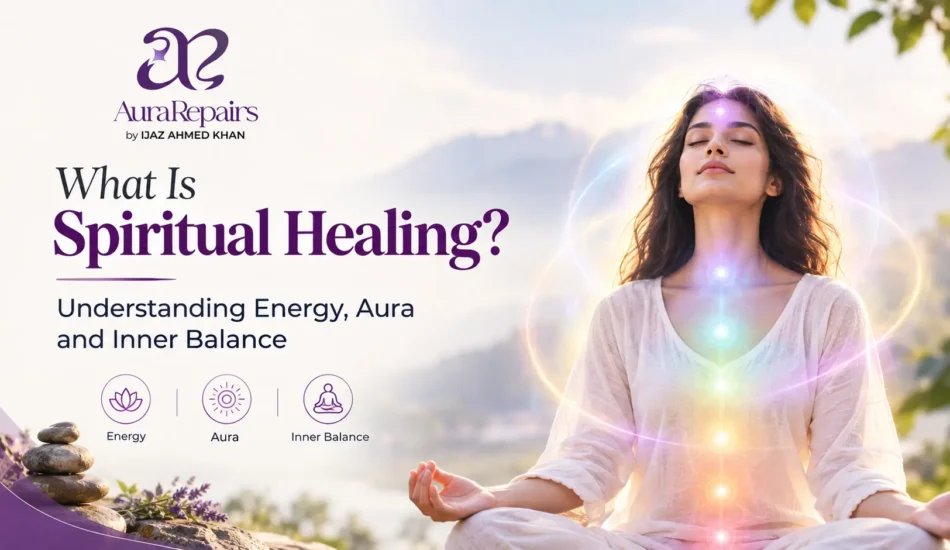
Spiritual Healing is a holistic approach that focuses on a person’s inner wellbeing, sense of connection, emotional balance, spiritual awareness, and personal energy. While different cultures and traditions understand spiritual Healing in different ways, many approaches share the idea that wellbeing involves more than physical health alone.
People exploring spiritual Healing may be looking for greater inner peace, emotional clarity, energy balance, or a deeper understanding of themselves. Some may explore practices such as meditation, prayer, mindfulness, spiritual counselling, energy healing, aura work, or other complementary approaches.
But what exactly is spiritual Healing? How are energy and aura connected to the concept, and what does inner balance actually mean?
In this guide, we explore spiritual Healing from a holistic perspective, explain commonly used terms such as aura healing, energy balance, spiritual wellbeing, aura cleansing, and inner Healing, and discuss what someone can expect when exploring these practices.
Spiritual Healing is used in different ways across cultures and traditions. Concepts such as an aura or subtle energy are spiritual or complementary frameworks, not established medical diagnoses. Spiritual practices should complement—not replace—appropriate medical or mental-health care.
What Is Spiritual Healing?
Spiritual Healing generally refers to practices intended to support spiritual wellbeing, inner peace, self-awareness, emotional balance, and a person’s sense of connection or meaning.
No single universal definition of spirituality exists. A systematic review of definitions used in healthcare found that spirituality is commonly associated with meaning, connection, and an individual’s sense of purpose.
Depending on the individual and tradition, spiritual Healing may involve:
- Meditation and mindfulness
- Prayer or reflective practices
- Spiritual counselling
- Energy healing practices
- Aura-focused practices
- Breathwork
- Relaxation techniques
- Personal reflection
- Chakra-based practices
- Compassion and connection
- Holistic wellbeing practices
The goal is often not simply to address one physical symptom but to encourage a greater sense of inner balance and spiritual wellbeing.
Research into spirituality and health has also explored how spiritual care and spiritual practices may relate to quality of life, wellbeing, coping, and other outcomes. However, results vary by intervention type and population studied.
How Are Energy and Aura Connected to Spiritual Healing?
Energy and aura are central to many spiritual and holistic traditions.
In these traditions, the aura is commonly described as a subtle energy field surrounding a person. Practitioners may use concepts such as energy flow, energy balance, aura cleansing, energy blocks, and energetic alignment to describe a person’s spiritual or emotional state.
From a spiritual perspective, an aura may be viewed as part of the person’s overall energetic environment. Some people therefore seek aura healing or aura repair when they feel emotionally overwhelmed, spiritually disconnected, or energetically unsettled.
It is important to distinguish this spiritual framework from scientific measurement. For example, the U.S. National Centre for Complementary and Integrative Health describes energy-healing practices as complementary approaches, but notes that for Reiki specifically, no scientific evidence currently establishes the existence of the energy field proposed by the practice.
Therefore, terms such as aura energy, spiritual energy, energy cleansing, and aura balance should be understood according to the particular spiritual tradition or practitioner using them.
What Does Inner Balance Mean in Spiritual Healing?
Inner balance generally refers to a sense of harmony between different aspects of your life—including thoughts, emotions, values, relationships, spirituality, and daily experiences.
When people search for spiritual Healing, they may describe their concerns in everyday language:
- “I feel emotionally drained.”
- “I don’t feel like myself.”
- “I feel disconnected.”
- “I need more peace in my life.”
- “I feel overwhelmed by negative situations.”
- “I want to understand my energy better.”
- “I want to reconnect with myself.”
Spiritual healing approaches may encourage people to slow down, reflect, identify sources of stress, build self-awareness, and explore practices that align with their beliefs.
This broader approach is consistent with the growing interest in whole-person wellbeing. A major review published in JAMA found that spirituality can be relevant to health and serious illness. It recommended incorporating spiritual considerations into person-centred care where appropriate.
What Are the Common Signs People Associate With Energy Imbalance?
Different spiritual traditions describe energy imbalance differently, so no medically standardised checklist exists for identifying an “imbalanced aura.”
However, people who explore aura and energy practices may describe experiences such as:
1. Feeling Emotionally Drained
You may feel mentally or emotionally exhausted after prolonged stress, difficult relationships, or challenging life experiences.
2. Feeling Disconnected From Yourself
Some people seek spiritual guidance when they feel disconnected from their values, purpose, or usual sense of identity.
3. Difficulty Finding Inner Peace
Constant worry, pressure, or emotional tension can make it difficult to relax and feel centred.
4. Feeling Overwhelmed by Your Environment
Some people use the language of “negative energy” to describe environments or interactions that leave them feeling uncomfortable or emotionally exhausted.
5. Wanting Greater Spiritual Clarity
A person may want to understand their spiritual beliefs, emotions, personal direction, or sense of purpose more deeply.
These experiences can have many possible explanations, including ordinary life stress and mental or physical health concerns. You can explore spiritual practices as complementary wellbeing approaches, but discuss persistent or severe symptoms with an appropriate healthcare professional.
What Is Aura Healing and Aura Repair?
Aura healing and aura repair are terms used within certain spiritual and energy-healing practices.
Although terminology differs between practitioners, aura healing generally focuses on supporting what is described as the person’s energetic or spiritual field. Aura repair may be described as addressing perceived energetic disturbances, imbalances, or areas requiring attention.
For someone unfamiliar with these concepts, the difference can be confusing.
In simple terms:
| Term | Common Spiritual Meaning |
|---|---|
| Aura | A spiritual or energetic field associated with a person |
| Aura Healing | A practice focused on supporting perceived energetic balance |
| Aura Repair | A practice described as addressing perceived energetic disturbances |
| Aura Cleansing | A spiritual practice intended to clear perceived unwanted energy |
| Energy Healing | A broad category of complementary practices involving concepts of energy |
| Spiritual Healing | A broader approach focused on spiritual wellbeing, meaning, connection, and inner balance |
These definitions can vary significantly between spiritual traditions and practitioners.
For people who are unsure whether they need aura repair, aura healing, or another spiritual service, an initial Aura Diagnostic & Mapping session may be presented as a way to explore their concerns and understand which approach may be appropriate within that practitioner’s framework.
What Happens During a Spiritual Healing Session?
A spiritual healing session can vary by practitioner, method, and individual goals.
A session may include:
- Initial discussion – The practitioner may ask about your concerns, experiences, goals, or reasons for seeking spiritual support.
- Assessment or mapping – Some practitioners use an aura or energy assessment to identify areas they believe need attention.
- Spiritual or energy practice – Depending on the approach, this may involve meditation, guided relaxation, prayer, energy work, visualisation, or other practices.
- Reflection – The practitioner may discuss observations or experiences from the session.
- Personal guidance – You may receive suggestions for reflection, mindfulness, relaxation, or continued spiritual practice.
The experience is not necessarily the same for everyone. If you are considering a session, ask the practitioner what method they use, what the session involves, how long it lasts, and what you can realistically expect.
Can Spiritual Healing Be Done Online?
Yes, some practitioners offer online spiritual Healing, remote energy sessions, online aura consultations, and distance spiritual support.
Remote sessions may take place through video calls or other communication platforms. The structure varies by practitioner.
For example, an online session may include:
- A consultation about your concerns
- Discussion of your spiritual or personal goals
- Aura or energy-focused assessment
- Guided spiritual practices
- Meditation or relaxation
- Follow-up guidance
For people who cannot attend an in-person appointment, remote spiritual Healing can provide a convenient way to explore a practitioner’s approach from home.
However, claims about remote energy healing should be understood within the relevant spiritual tradition rather than assumed to be scientifically established medical treatment. Research into distant or energy-based Healing has produced mixed and limited evidence, and the mechanisms proposed by some practices have not been established scientifically.
What Are the Potential Benefits of Spiritual Healing?
People explore spiritual Healing for many different personal reasons.
Potentially meaningful areas may include:
- Greater self-reflection
- A stronger sense of purpose
- Emotional awareness
- Relaxation
- Spiritual connection
- Mindfulness
- Personal growth
- Sense of inner peace
- Support during difficult life experiences
- Improved awareness of personal values
Research on spiritual interventions has reported associations with aspects of wellbeing and quality of life. However, evidence varies considerably by intervention, study design, and population. A 2025 systematic review and meta-analysis, for example, examined several types of spiritual interventions and reported improvements in spiritual wellbeing and quality of life among adults with cancer.
This does not mean every spiritual healing technique will produce the same results, or that spiritual Healing can treat a medical condition.
Spiritual Healing vs Medical Treatment: What Is the Difference?
One of the most important things to understand is that spiritual Healing and medical treatment serve different purposes.
Medical treatment is based on clinical assessment, diagnosis, scientific evidence, and established healthcare practices.
Spiritual Healing generally focuses on areas such as:
- Spiritual wellbeing
- Meaning and purpose
- Inner reflection
- Personal beliefs
- Emotional and spiritual connection
- Complementary wellbeing practices
Some people may choose to explore spiritual practices alongside conventional healthcare. This is known as a complementary or integrative approach.
The National Centre for Complementary and Integrative Health emphasises the importance of evaluating the usefulness and safety of complementary approaches through scientific research.
If you have a medical condition, significant psychological symptoms, or an urgent health concern, seek appropriate professional healthcare rather than relying solely on spiritual Healing.
How to Start Your Spiritual Healing Journey
If you are curious about spiritual Healing, aura healing, energy balance, or inner Healing, start with clear and realistic expectations.
Identify Your Goal
Ask yourself what you want to explore. Are you looking for spiritual clarity, personal reflection, relaxation, or a better understanding of your feelings?
Learn About the Practitioner
Before booking a session, research the practitioner’s approach, experience, services, and how they explain their methods.
Ask Questions
You can ask:
- What happens during the session?
- What does aura Healing mean in your practice?
- Do you offer online sessions?
- How long does a session take?
- What should I expect afterwards?
- Is this complementary to medical care?
Consider Aura Diagnostic & Mapping
If you’re unsure which service is right for you, an Aura Diagnostic & Mapping session can be a good starting point within some practitioners’ spiritual frameworks.
For Aura Repairs, this service can help clients explore their concerns before deciding whether they want Aura Repair, Aura Healing, or another available service.
Final Thoughts on Spiritual Healing, Aura and Inner Balance
Spiritual Healing is a broad concept that can mean different things to different people. At its core, it often involves exploring spiritual wellbeing, inner peace, personal meaning, energy, self-awareness, and connection.
Concepts such as aura, energy balance, aura cleansing, chakra alignment, and aura repair belong primarily to spiritual and complementary frameworks. While research supports the relevance of spirituality and spiritual wellbeing in holistic and person-centred care, approach specific claims about invisible energy fields or energy healing with appropriate scientific caution.
If you are interested in exploring spiritual Healing, choose an approach that respects your beliefs, provides clear information about what the session involves, and complements appropriate healthcare when needed.
If you’re unsure where to begin, you can explore Aura Diagnostic & Mapping as an introductory option before considering services such as aura repair or aura healing.


