



The human mind is one of the most fascinating and complex parts of who we are. Every thought, emotion, decision, memory, and reaction is influenced by different psychological processes working together. Psychology helps us understand these processes and provides insight into why people think, feel, and behave in particular ways.
From everyday decisions to relationships, learning, motivation, stress, and personal development, psychology plays an important role in almost every area of life. By exploring psychology, we can better understand ourselves and the people around us.
In this guide, we will unpack the basics of psychology, explore how the mind works, examine the connection between thoughts and behaviour, and look at how psychological principles can be applied to everyday life.
What Is Psychology?
Psychology is the scientific study of the mind and behaviour. It explores how people think, experience emotions, learn, remember information, develop throughout life, interact with others, and respond to different situations.
Psychologists study both conscious and unconscious processes. While some behaviours are intentional and easy to understand, others can be influenced by experiences, habits, emotions, beliefs, or mental processes that we may not immediately recognize.
Psychology is not simply about studying mental health. Although mental health is an important part of psychology, the field is much broader. It also includes subjects such as memory, personality, learning, motivation, social interaction, decision-making, development, and human behaviour.
How Does the Human Mind Work?
The human mind processes an enormous amount of information every day. We constantly receive information through our senses, interpret what is happening around us, connect new information with previous experiences, and decide how to respond.
For example, imagine receiving an unexpected message from someone you know. Your brain may immediately interpret the words, remember previous conversations with that person, consider their tone, and create an emotional response. The same message could make one person feel excited while making another person feel worried.
This happens because our responses are influenced by more than the event itself. Past experiences, expectations, beliefs, personality, emotional state, and surrounding circumstances can all influence how we interpret information.
Psychology helps researchers understand these mental processes and their contributions to human behaviour.
The Connection Between Thoughts, Emotions, and Behaviour
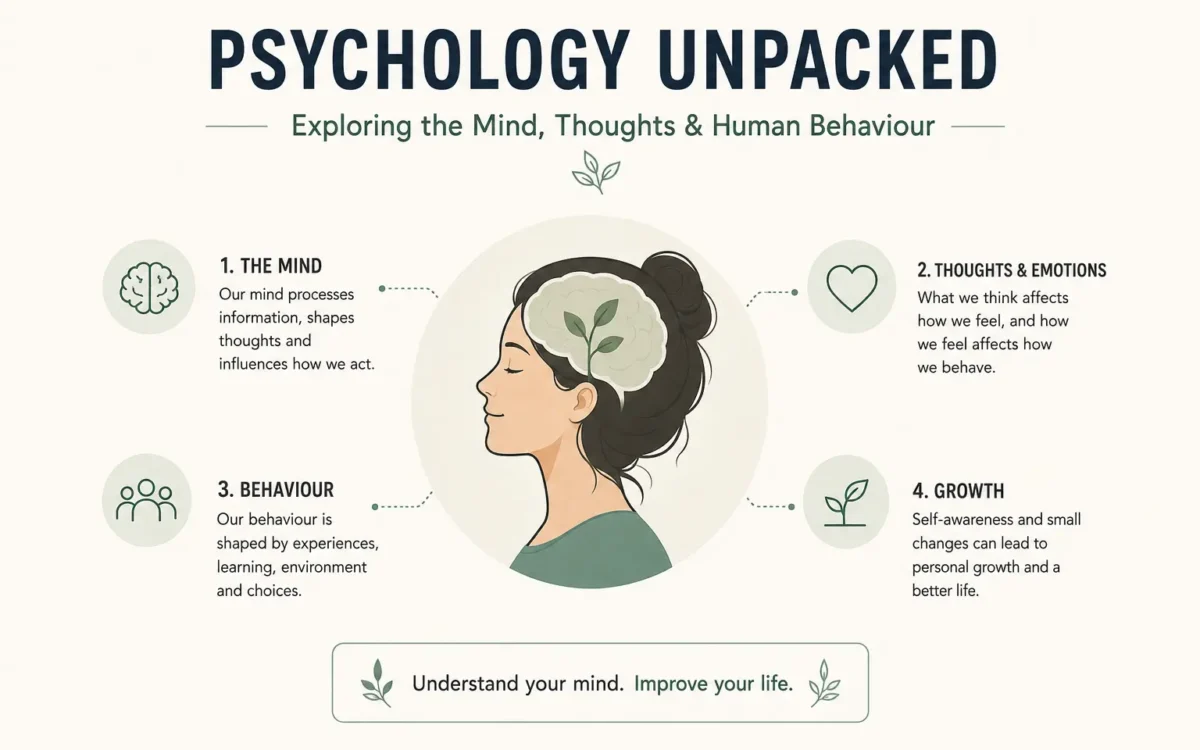
Thoughts, emotions, and behaviour are closely connected. What we think about a situation can influence how we feel, and those feelings can affect how we behave.
For example, a person who believes they are likely to fail an important presentation may experience anxiety before speaking. That anxiety could make them avoid preparation or feel uncomfortable while presenting. On the other hand, someone who believes they can prepare effectively may approach the same situation with greater confidence.
This does not mean that positive thinking automatically solves every problem. Instead, it demonstrates how interpretations and beliefs can influence emotional and behavioural responses.
Understanding this connection can help people become more aware of their reactions and identify patterns that may affect their daily lives.
Major Areas of Psychology
Psychology is a broad field containing many specialized areas. Each area focuses on different aspects of the human mind and behaviour.
Cognitive Psychology
Cognitive psychology focuses on mental processes such as thinking, memory, attention, learning, language, problem-solving, and decision-making.
It explores questions such as how people remember information, why they sometimes forget things, how they solve problems, and how they process information from their surroundings.
Cognitive psychology is particularly useful for understanding how people make decisions and how mental shortcuts can sometimes influence judgment.
Behavioral Psychology
Behavioural psychology examines how experiences and the environment influence behaviour. It focuses on observable actions and how behaviours can be learned, reinforced, or changed.
For example, if a rewarding outcome consistently follows a particular behaviour, a person may become more likely to repeat that behaviour. Similarly, behaviours that produce unwanted consequences may become less frequent.
Behavioural principles are used in education, workplace environments, parenting, personal development, and many other settings.
Developmental Psychology
Developmental psychology examines how people change throughout their lives. It can include physical, cognitive, emotional, and social development from childhood through adulthood and later life.
Researchers study how early experiences, relationships, education, environment, and biological factors can influence development.
Understanding development can help explain why people may think and behave differently at different stages of life.
Social Psychology
Social psychology explores how other people and social environments influence people’s thoughts, feelings, and behaviours.
Topics include relationships, group behaviour, social influence, communication, attitudes, stereotypes, conformity, and interpersonal interactions.
For example, people may behave differently when they are alone compared with when they are part of a group. Social psychology helps explain some of the factors behind these differences.
Personality Psychology
Personality psychology focuses on individual differences in patterns of thinking, feeling, and behaving.
People have different personalities, preferences, emotional tendencies, motivations, and ways of responding to situations. Personality psychology explores these differences and examines how biological factors, experiences, and environments may contribute to personality development.
Biological Psychology
Biological psychology examines the relationship between biological processes and behaviour. It considers how the brain, nervous system, hormones, genetics, and other biological systems can influence thoughts, emotions, and actions.
This area demonstrates that human behaviour cannot always be understood by looking at psychological experiences alone. Biological and environmental factors often interact with each other.
How Thoughts Influence Behaviour
Thoughts can strongly influence the way people respond to everyday situations. Before taking action, people often interpret what is happening and form an opinion about its meaning.
Consider someone who receives constructive criticism at work. One person may interpret it as an opportunity to improve, while another may see it as evidence that they are not capable. Although the external event is similar, their interpretations may lead to very different emotional and behavioural responses.
This is one reason self-awareness is valuable. Recognizing recurring thought patterns can help people understand why they respond to certain situations in particular ways.
Understanding Human Emotions
Emotions are an important part of human psychology. Happiness, sadness, anger, fear, surprise, frustration, excitement, and many other emotional experiences can influence attention, decisions, communication, and behaviour.
Emotions can provide useful information about what a person is experiencing. For example, fear may signal that someone perceives a threat, while frustration may indicate that something is preventing them from reaching a desired goal.
However, emotions do not always provide a complete picture of a situation. A strong emotional response can sometimes influence judgment or encourage an immediate reaction.
Learning to recognize and understand emotions can therefore contribute to better communication, decision-making, and self-awareness.
Why Do People Behave Differently?
People can experience the same situation but respond to it in completely different ways. This happens because many interacting factors influence behaviour.
Some important influences include:
- Personality and individual characteristics
- Previous experiences
- Family and social environment
- Culture and social expectations
- Beliefs and values
- Current emotional state
- Physical and biological factors
- Education and learning
- Immediate circumstances
- Expectations about the future
For example, two people may be asked to speak in front of a group. One may see it as an exciting opportunity, while the other may find it intimidating. Their different reactions may reflect differences in previous experiences, confidence, personality, expectations, and interpretation of the situation.
The Role of Memory and Learning
Memory allows people to store and retrieve information from previous experiences. It plays an important role in learning, relationships, decision-making, and everyday activities.
Learning occurs when experiences and information contribute to changes in knowledge, skills, or behaviour. People can learn through direct experience, observation, education, practice, feedback, and interaction with others.
Memory is not always a perfect recording of events. Human memory can be influenced by attention, emotions, later information, expectations, and other factors. This is why two people can remember the same event differently.
Understanding memory and learning helps explain how people develop skills, form habits, and adapt to new situations.
How Environment Shapes the Mind
Human behaviour is influenced not only by individual characteristics but also by the environment in which a person lives and develops.
Family relationships, education, friendships, workplace experiences, cultural expectations, and social surroundings can all contribute to how people think and behave.
For example, a supportive learning environment may encourage curiosity and confidence, while one characterized by constant criticism may shape how someone responds to challenges.
The influence of environment does not mean that people have no individuality or personal control. Rather, psychology recognizes that behaviour often develops through interactions between individual characteristics and environmental experiences.
Psychology in Everyday Life
Psychology is not limited to laboratories, universities, or clinical settings. Psychological principles can be applied to many everyday situations.
Communication
Understanding emotions, body language, attention, and social behaviour can improve communication. Listening carefully and considering another person’s perspective can help reduce misunderstandings.
Learning
Knowledge about attention, memory, repetition, and motivation can help people develop more effective study habits and learning strategies.
Relationships
Understanding individual differences and emotional responses can help people communicate more effectively and build healthier relationships.
Decision-Making
Psychology can help people recognize that emotions, assumptions, habits, social pressure, and mental shortcuts may influence decisions.
Personal Development
Understanding personal thought patterns and behaviours can encourage self-reflection and help people identify areas where they want to grow.
How Psychology Can Improve Self-Awareness
One of the most useful applications of psychology is the development of self-awareness. Self-awareness means becoming more conscious of your thoughts, emotions, behaviours, strengths, limitations, and personal patterns.
For example, someone might notice that they tend to postpone difficult tasks because they feel overwhelmed. Instead of simply labelling themselves as lazy, they can examine what happens before the behaviour occurs.
Perhaps the task feels too large, they are afraid of making mistakes, or they do not know where to begin. Understanding the underlying pattern can make it easier to identify practical ways to respond differently.
Self-awareness does not mean analyzing every thought or emotion. It simply involves developing a clearer understanding of your internal experiences and how they influence your actions.
Common Myths About Psychology
There are many misconceptions about psychology. One common myth is that psychology is simply about reading people’s minds. In reality, psychologists use scientific research, observation, assessment, and evidence-based methods to study mental processes and behaviour.
Another misconception is that psychology only focuses on problems or mental illness. Psychology also examines healthy development, learning, motivation, relationships, personality, performance, and many other aspects of human life.
It is also incorrect to assume that every behaviour has one simple explanation. Multiple factors often influence human behaviour, and understanding those factors requires careful consideration of the individual and their circumstances.
Why Understanding Psychology Matter
Psychology provides a framework for understanding the complexity of human behaviour. It encourages us to look beyond immediate reactions and consider the thoughts, emotions, experiences, biological factors, and environmental influences that may contribute to behaviour.
This understanding can be valuable in education, relationships, workplaces, parenting, personal development, communication, and many other areas.
Most importantly, psychology reminds us that human behaviour is complex. A single reaction, personality trait, or experience does not define people. Our minds and behaviours can change as we learn, develop, and respond to new experiences.
Conclusion
Psychology offers a fascinating way to explore what makes us think, feel, learn, remember, and behave the way we do. From cognitive processes and emotions to personality, social relationships, learning, and environmental influences, psychology shows that many interconnected factors shape human behaviour.
Exploring psychology does not mean finding a simple explanation for every thought or action. Instead, it encourages curiosity and deeper understanding. By becoming more aware of our thoughts, emotions, experiences, and behavioural patterns, we can gain valuable insight into ourselves and our interactions with others.
The mind may be complex, but psychology gives us a structured way to begin understanding it. Whether you are interested in human behaviour, personal growth, relationships, learning, or simply curious about why people act the way they do, psychology provides an opportunity to explore the fascinating world within us.


